Complete Guide to the HexClad Lawsuit in 2025
Introduction
The HexClad case is now among the most widely discussed legal news stories in the cookware world. Renowned for its space-age hybrid pans and celebrity supporters, HexClad established its brand on luxury design and a lifetime of performance. Yet recent suits have questioned some of those guarantees, raising questions about honesty in marketing and what consumers have a right to learn.
In this complete guide, we’ll unpack everything: what triggered the HexClad lawsuit, what the allegations are, how the company responded, and how it could reshape cookware marketing forever. Have you checked our detailed guide on Simply Orange Lawsuit.
What Is the HexClad Lawsuit?
The HexClad lawsuit describes a string of consumer complaints filed against HexClad, claiming that the cookware fails to meet its aggressive advertising promises. According to the plaintiffs, words such as “lifetime durability” and “metal-utensil safe” could have misled consumers, as some of them experienced scratches, worn-off coatings, or quicker-than-anticipated wear.
Another key issue is chemical safety specifically the cookware’s stated status as PFOA-free and “non-toxic.” Skeptics wonder if minimal levels of PFAS (per- and polyfluoroalkyl substances), also called forever chemicals, could still be present in some manufacturing or supply processes.
These lawsuits don’t allege HexClad intentionally hurt consumers — instead, they question whether the firm’s advertising truthfully describes its product performance and makeup.
The Rise of HexClad
HexClad Cookware exploded onto the scene in 2016 with a revolutionary claim: pots that mingled the durability of stainless steel with the convenience of non-stick cooking. The company’s hexagonal laser-etched design was immediately iconic, and before long, celebrity chef Gordon Ramsay endorsed the brand, sending its popularity around the world.
The brand’s marketing touted key benefits:
- Dishwasher and oven safe
- Metal utensil resistant
- Non-toxic and “PFOA-free”
- Lifetime warranty on performance
Its modern matte-black appearance and strong marketing caused it to sweep the premium cookware market. But when sales went through the roof, consumer complaints started rolling in — especially regarding non-stick wear and tear and warranty replacements.
By 2023, those complaints had reached the stage of coordinated legal action, leading to what became known as the HexClad lawsuit.
Why Did the Lawsuit Arise?
There is no single reason; instead, there is a combination of marketing, expectations, and environmental awareness that culminated in the perfect storm.
1. Claims of Misleading Advertising
The center of the HexClad lawsuit is based on whether the company’s claim was overblown or misinterpreted. HexClad advertises “metal-safe” use, yet several users reported scratches or degradation of coating upon regular cooking, calling into question the durability guarantee.
2. Chemical Transparency
The cookware market is under international scrutiny for PFAS — man-made chemicals that won’t readily degrade. Although HexClad states that it’s “PFOA-free,” lawsuits contend that the terminology does not necessarily equate to absolutely free of all PFAS compounds, which customers tend to interpret.
3. Warranty and Refund Issues
Some customers complained of difficulty in obtaining the brand’s “lifetime warranty.” Rejected claims and poor customer service added to frustration, prompting some to engage in class actions complaining of fraudulent warranty practices.
4. Marketing Through Influencers
Celebrity endorsements can be a trust builder — but a bust when controversies erupt. HexClad gained cache with Gordon Ramsay’s endorsement, but critics argue the celebrity tie might have deceived some customers into believing unmatched quality without proof.
Timeline of the HexClad Lawsuit
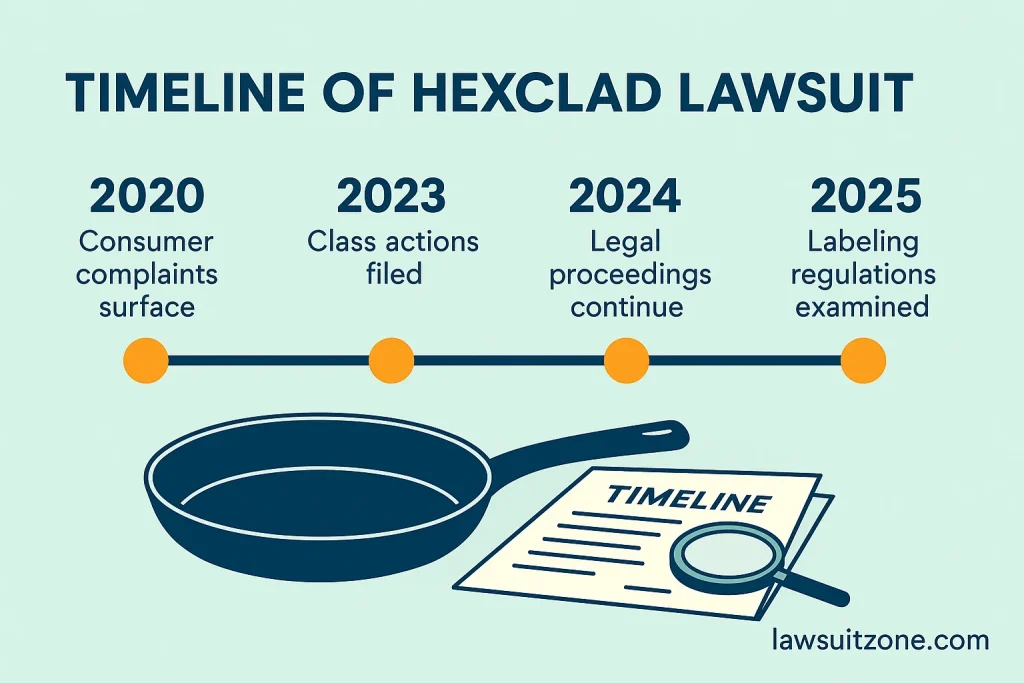
- 2016-2019: HexClad expands quickly with online sales and influencer marketing.
- 2020: Initial consumer complaints on social media and forums regarding scratching and wear of the non-stick.
- 2021: The business goes global; similar hybrid technology competitor brands start testing.
- 2022: PFAS becomes a hot topic in the U.S., and safety lawsuits against cookware spread across the industry.
- 2023: First class-action filings are seen, naming HexClad as one of the brands supposedly exaggerating product durability or safety.
- 2024: Legal deliberations and testing reviews are ongoing; no liability has yet been established.
- 2025: Cases are still pending, with increased focus on cookware labeling regulations.
No court has yet ruled HexClad guilty of anything at this point — investigations are primarily aimed at confirming statements and assessing transparency.
Learning About PFAS and Why It’s Important
To understand the HexClad lawsuit, you must be aware of PFAS — a group of chemicals previously applied in non-stick coatings such as Teflon. PFAS compounds are heat, oil, and water-resistant, which qualifies them for use in cookware. Sadly, they do not biodegrade and can remain in the environment and human body for years.
High levels of PFAS have been linked to long-term exposure with:
- Hormonal interference
- Liver and kidney problems
- Immune suppression
- Specific cancers
Although contemporary cookware may be “PFOA-free,” that does not necessarily imply PFAS-free. This is the crux of many recent legal cases, including HexClad’s.
For scientific and regulatory information about PFAS, go to the official U.S. Environmental Protection Agency (EPA). It contains comprehensive information on chemical safety, food-contact materials, and national testing being conducted.
Who Can Join the HexClad Lawsuit?
If the case is approved as a class action, potential participants could be consumers who bought HexClad cookware and did so in reliance on certain product representations. Qualification typically requires:
- Proof of purchase within the relevant timeframe
- Advertising reliance (i.e., you purchased it in reliance on “non-toxic,” “metal-safe,” or “lifetime” representations)
- Documented problems such as wear, coating loss, or rejected warranty claims
You don’t need to prove illness or injury class actions like this one typically involve financial damage or false marketing.
When a settlement or claim period is open, official administrators will give guidance on how to submit and validate eligibility.
Potential Compensation and Outcomes
If the HexClad lawsuit goes to a conclusion, these are the most probable outcomes:
Financial Refunds or Partial Reimbursement
Customers who had experienced premature wear or other legitimate problems might be entitled to cash refunds.
Product Replacement or Credit
Businesses tend to provide vouchers or replacement products for use in subsequent purchases.
Policy and Labeling Changes
The court might direct HexClad to change its “non-stick” or “lifetime guarantee” statements to accurately represent confirmed results.
Corporate Auditing
Settlements can include third-party audits to ensure manufacturing and labeling comply with industry standards.
Market-Wide Reform
The case might spur wider regulation and greater transparency among cookware companies.
HexClad’s Official Statement
HexClad Cookware asserts its products are safe and properly represented. The company focuses on the use of PFOA-free materials and quality control prior to distribution.
Publicly and in media interviews, spokespeople explained that:
- The company supports its hybrid technology, which incorporates a stainless steel lattice for non-stick coating protection.
- Appropriate care — not extreme heat and harsh cleaners — guarantees long-lasting performance.
- No valid testing has established harmful levels of PFAS in its cookware.
HexClad contends that the lawsuits represent misinterpretations, not evidence of fraud or harm.
Industry Impact
The HexClad lawsuit served notice to other cookware brands. Brands are rethinking how they characterize “eco-friendly,” “non-stick,” or “chemical-free” features. Expect to see tighter testing and labeling in the future.
Online Buzz
Social media sites, Reddit forums, and cooking forums are rife with impassioned arguments. Even while some chefs swear by HexClad’s performance, skeptics are calling for greater disclosure of the materials involved.
Why This Lawsuit Matters
The HexClad lawsuit is not just about pans — it’s about corporate integrity and consumer protection. When brands make claims like “non-toxic” or “forever warranty,” they are playing on emotional trust. The lawsuit calls out brands to live up to those promises with science that checks out.
For Consumers
It’s a wake-up call to look past marketing. Always read care instructions, warranty terms, and ingredient label disclosures before buying cookware.
For Businesses
The message is unmistakable: truth outsells hype. Exaggerating promises results in lawsuits; being true to oneself creates long-term loyalty.
For Regulators
This lawsuit is part of an increasing trend toward clarification of what “safe,” “green,” and “sustainable” actually mean in the eyes of the law.
Key Takeaways from the HexClad Lawsuit
- Transparency Is Everything: Honest communication establishes better brands than glitzy marketing.
- Consumers Are Empowered: Today’s buyers learn about products extensively — deceptive language can quickly backfire.
- Science Needs To Back Up Claims: Third-party testing is essential to prevent mislabeling.
- Regulation Is Catching Up: Lawsuits such as this force better labeling and safety regulations.
Common Myths and Facts
Myth 1: The HexClad lawsuit confirms the cookware is unsafe.
Fact: There’s no recall or scientific evidence of hazard. The disagreement centers on labeling and advertising, not toxicity.
Myth 2: Joining a lawsuit is complicated or risky.
Fact: Class actions are straightforward — lawyers handle the process, and you pay nothing upfront.
Myth 3: All non-stick cookware is harmful.
Fact: Many brands now use safe, PFAS-free coatings verified by independent testing.
Myth 4: The lawsuit will shut down HexClad.
Fact: Not at all. The company continues operations and product releases while addressing legal concerns.
Broader Implications for Cookware Marketing
The result of the HexClad lawsuit will have a big impact on how cookware is marketed in the coming decade. Look for:
- Greater labeling specificity with honest chemical disclosures
- Independent third-party safety ratings
- More realistic warranty terms rather than “lifetime” marketing fluff
- Transparency reports like the sustainable clothing brands have adopted
It’s a consumer win for health and honesty.
Frequently Asked Questions (FAQs)
Final Thoughts
The HexClad lawsuit is a turning point for consumers and manufacturers alike. It’s a reminder that today’s shoppers demand honesty, evidence, and accountability rather than marketing pizzazz.
Whether HexClad wins or settles, the wider impact will flow through the industry, setting a higher standard for how cookware brands describe safety and performance.
For typical consumers, the takeaway is straightforward: ask questions, read labels, and don’t mistake advertising bravado for scientific evidence.
With the changing world of cookware, one thing holds true transparency is the most popular trend in any kitchen.
Disclaimer
This article is for informational purposes only. It is not legal advice and does not create an attorney-client relationship. Always consult a licensed lawyer for particular legal issues.