EA Class Action Lawsuit 2025: Full Gaming Guide
Introduction: The Day Gamers Spoke Out
Decades ago, video games were a refuge a form of art that introduced laughter, rivalry, and narrative to living rooms globally. Yet as the technology progressed, so did the models. These were no longer mere one-time buys; they were now recurring ecosystems where users were invited to continue spending long after the initial purchase.
No publisher embodies this transformation more than Electronic Arts (EA). With iconic franchises such as FIFA, Madden NFL, Battlefield, and The Sims, EA has dominated the world market. However, its aggressive emphasis on microtransactions and loot boxes has also established it as one of the most controversial publishers.
The negative reaction intensified so much that gamers united in what is currently referred to as the EA class action lawsuit. This case, which cuts across multiple nations and extends into 2025, is not about a single company it’s about the future of gaming in general.
This guide will take you through the lawsuit step by step, including:
- Why EA is being sued over loot boxes.
- The worldwide timeline of court fights.
- How EA is defending itself and what it has done in response.
- The psychological aspects of loot box addiction.
- The effects on players, regulators, and the broader gaming community.
- What can be learned by gamers and developers.
The History of the EA Class Action Lawsuit
EA’s Reputation: Love and Hate
EA has always operated at the crossroads of innovation and criticism. On the one hand, the publisher provided us with iconic franchises. On the other, it was named “Worst Company in America” several times through consumer-hostile practices.
A few of the past controversies were:
- DLC on Disc: Paying gamers to unlock content that was pre-installed in games.
- Madden Exclusivity: Securing NFL licensing, annoying fans of rival gridiron games.
- Server Shutdowns: Withdrawing support from old games too abruptly.
But nothing stung worse than the loot box period.
Loot Boxes Explained: Why Gamers Labelled Them As Gambling
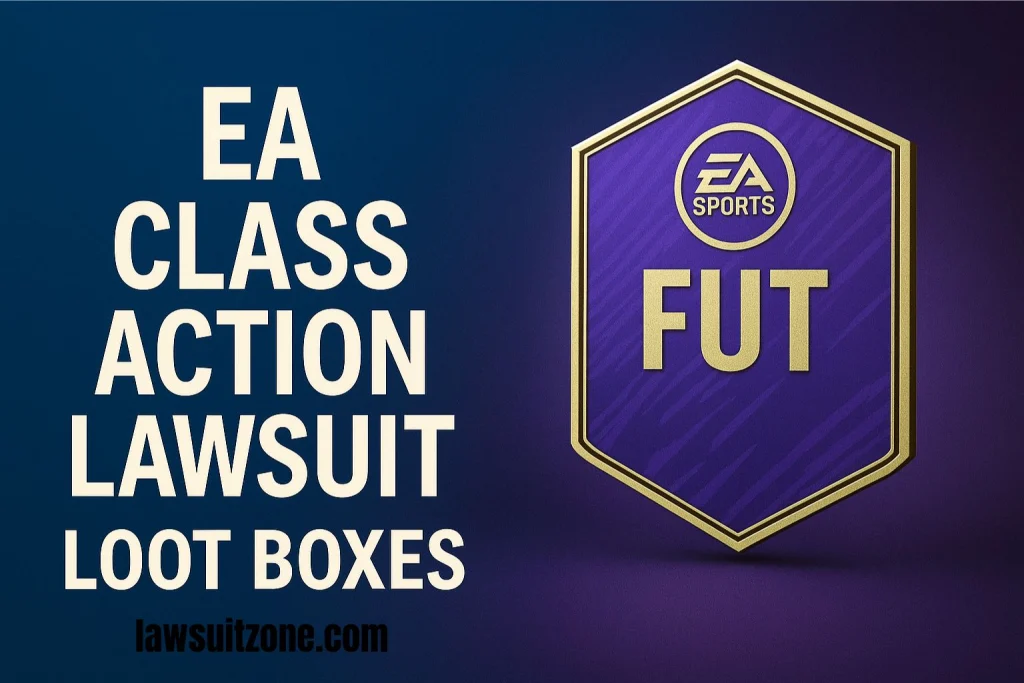
At the center of the lawsuit are loot boxes digital bundles that players buy without knowing precisely what they’ll receive.
- In FIFA Ultimate Team (FUT), these bundles could contain superstar players such as Messi or Mbappé or merely mediocre ones.
- In Madden NFL, card bundles decided team power.
- In Battlefield and other titles, loot boxes included skins, guns, or performance-boosting items.
The problem? The items were random, and players might spend indefinitely pursuing rare rewards. Have you checked our detailed guide on meaningful beauty lawsuit.
Why Critics Viewed Loot Boxes as Gambling
- Chance-Based Rewards: Players pay cash with no assured value.
- Psychological Manipulation: The “near-miss” triggers the same rush of dopamine as slot machines.
- Younger Audiences: Players were often minors with access to credit cards belonging to their parents.
- Lack of Transparency: Chances to win scarce items were concealed or hard to discover.
- Pay-to-Win: Payments more frequently translated to controlling competitive playlists.
This is what made fun into exploitation, plaintiffs assert.
Timeline of the EA Class Action Lawsuit
- 2017: EA releases Star Wars Battlefront II with aggressive loot boxes. Outrage spreads globally, even attracting political notice.
- 2018: Early class-action suits filed in California and Canada against FIFA Ultimate Team packs.
- 2019: The Netherlands and Belgium move to outlaw loot boxes as gambling. EA resists at first, but then yields.
- 2020: Class-action lawsuits converge in Canada and the U.S. Charges: unlicensed gambling, predatory practices, false advertising.
- 2021: Canadian courts sanction significant class-action actions, creating a precedent.
- 2022: News emerges of children spending thousands unbeknownst to their parents.
- 2023: EA implements “pack odds” disclosures in some territories, but lawsuits persist.
- 2024: American legislators introduce bills against loot boxes. Europe widens probes.
- 2025 (Latest Update): Cases are still ongoing in several jurisdictions. Rumors of settlements, but a definitive judgment has yet to be made.
EA’s Defense Strategy
Loot Boxes Are Not Gambling
EA contends that:
- Players always get something for their money.
- Items have no cash value in real life.
- Loot boxes are akin to purchasing collectible trading cards.
Transparency Initiatives
In an attempt to soften criticism, EA adopted:
- Pack Odds Disclosure: Displaying percentages of drawing rare items.
- Preview Packs: Allowing players to view contents prior to purchase.
Prioritizing Player Choice
EA asserts that packs are voluntary and that gamers can still play games without spending money.
The Reality of Business
Lawsuits notwithstanding, loot boxes continue to be EA’s money cow. FIFA Ultimate Team raked in over $1.6 billion in revenue in 2020 alone close to 30% of EA’s overall revenue.
The Psychology of Loot Boxes
Why do gamers continue to spend, knowing the chances are low?
- Variable Ratio Rewards: The same system used by slot machines periodic victories keep gamblers engaged.
- FOMO (Fear of Missing Out): Temporary packs coerce players into instant purchases.
- Social Competition: Higher squads in FUT or Madden translate to more victories, encouraging players to spend to maintain.
- Youth Vulnerability: Young people tend to be impatient, so they are especially susceptible.
Complainants in the EA class action suit say these practices take advantage of human psychology in negative ways.
International Response to EA’s Loot Boxes
Europe
- Belgium & Netherlands: Prohibited loot boxes entirely as gambling.
- UK: Continuing parliamentary discussions. Some advocate regulation; others fall short of calling them gambling.
North America
- U.S.: Divided response. Various states introduced loot box regulation bills. Federal efforts remain scarce.
- Canada: Class actions advance, with courts becoming more open to comparisons with gambling.
Asia
- China: Mandates companies to report loot box probabilities.
- Japan: Formerly prohibited “kompu gacha,” a related mechanic.
This international schism demonstrates how complex the problem has now become.
The EA Class Action Lawsuit’s Impact
On Gamers
- Increased awareness of microtransaction danger.
- More vociferous demands for moral monetization.
- Parents more actively check children’s spending.
On EA
- FUT revenue continues to be high but in the firing line.
- Brand reputation has suffered; most gamers boycott EA games.
- Forced to implement more transparent mechanics.
On the Industry
- Similar criticism lands on publishers such as Activision, Ubisoft, and Take-Two.
- Move towards battle passes and cosmetic-only monetization.
- Developers promote themselves as “loot box-free” as a measure of consumer trust.
Player Stories: The Human Cost
There are real people behind every lawsuit.
- Alex, 17 (Canada): Wasted $3,000 of his parents’ money in pursuit of uncommon FUT cards. “It was like a slot machine. I couldn’t stop.”
- Maria, 32 (UK): “I thought I was just spending a few packs. Then I looked and seen that I’d spent over $500 one month.”
- James, 25 (U.S.): “I won Messi once. That rush kept me opening packs for weeks. But generally, I got nothing.”
Those experiences were compelling proof in the class action, describing how loot boxes can lead to compulsive gameplay.
Gamers’ Lessons
- Monitor Spending: Establish budgets and adhere to them.
- Read Odds: If a game makes drop rates known, do so.
- Watch Out for Free-to-Play Tricks: “Free” usually implies upfront aggressive monetizing later.
- Parental Vigilance: Watch out for in-game purchases by children.
- Know Your Rights: Depending on where you are, you might be entitled to refunds or compensation.
Lessons for Developers
- Transparency Builds Trust: Players appreciate honesty.
- Long-Term Reputation Over Short-Term Profit: Exploitation is profitable but destroys goodwill.
- Innovate Monetization: Cosmetic passes or subscription models are safer options.
- Anticipate Regulation: Adapt voluntarily before governments make you.
FAQs: EA Class Action Lawsuit 2025
Final Thoughts: A Defining Case for Gaming’s Future
The EA class action lawsuit update 2025 is more than a struggle between gamers and a publisher it’s a struggle for the heart of modern gaming.
For gamers, it’s a reminder to be mindful, aware, and proactive of spending tendencies.
For publishers like EA and others, it’s a reminder that short-term gains can’t be made at the expense of long-term trust.
For regulators, it’s a sign that laws need to catch up with digital economies.
Whether plaintiffs do or do not receive large settlements, the lawsuit has forever altered gaming. Loot boxes are no longer a mechanism they’re a warning. And as the industry continues towards 2030, one thing is certain: players will insist upon games that are not only enjoyable, but fair and transparent.