Class Action Lawsuit California: The Ultimate Claimant Guide

Introduction
If you’ve ever been in a group that was injured by a business, you may have hope in a class action lawsuit California. This kind of lawsuit allows many people who have been injured in the same way to join together and seek justice at the same time. In this guide you will learn what it is, how it works in California, your rights, and what to expect if you join. Have you checked our detailed guide on diddy Lawsuit.
What Is a California Class Action Lawsuit?
A class action lawsuit in California is a judicial vehicle whereby a myriad of similar plaintiffs sue a defendant collectively. Rather than each individual bringing their own case, a class action pools them, making it more efficient and sometimes less expensive. In California, the regulating rules permit state-level class actions as well as federal actions that are applicable in California—so the term “class action lawsuit California” encompasses both realms.
Why Use a Class Action Rather than an Individual Suit?
Using a class action rather than an individual suit has several benefits:
- It minimizes legal cost per individual because many are sharing one lawsuit.
- It places more pressure on a defendant when numerous claimants come together.
- It encourages fairness when individual claims are modest and wouldn’t be viable alone.
- It ensures uniform results for a group rather than fragmented verdicts.
Of course, it also comes with compromises: you may have less say in your claim and the payment per individual could be less. Nevertheless, for most injured persons in California, filing a class action lawsuit California is the most viable path for justice.
Who Can Be in the Class?

In order to be in a class action lawsuit California, you typically must satisfy three fundamental criteria:
- You are a member of the alleged “class” described in the complaint (e.g., buyers who paid for a defective product).
- Your claim or harm is of the same nature of wrongdoing complained of by others in the class.
- You agree to the conditions outlined in the class notice (or you decline to participate if you want to do it on your own).
If you get a mailed or posted “class notice,” take careful note of whether it concerns you, how to exclude yourself, and how to file a claim.
The Mechanics of a Class Action Lawsuit California
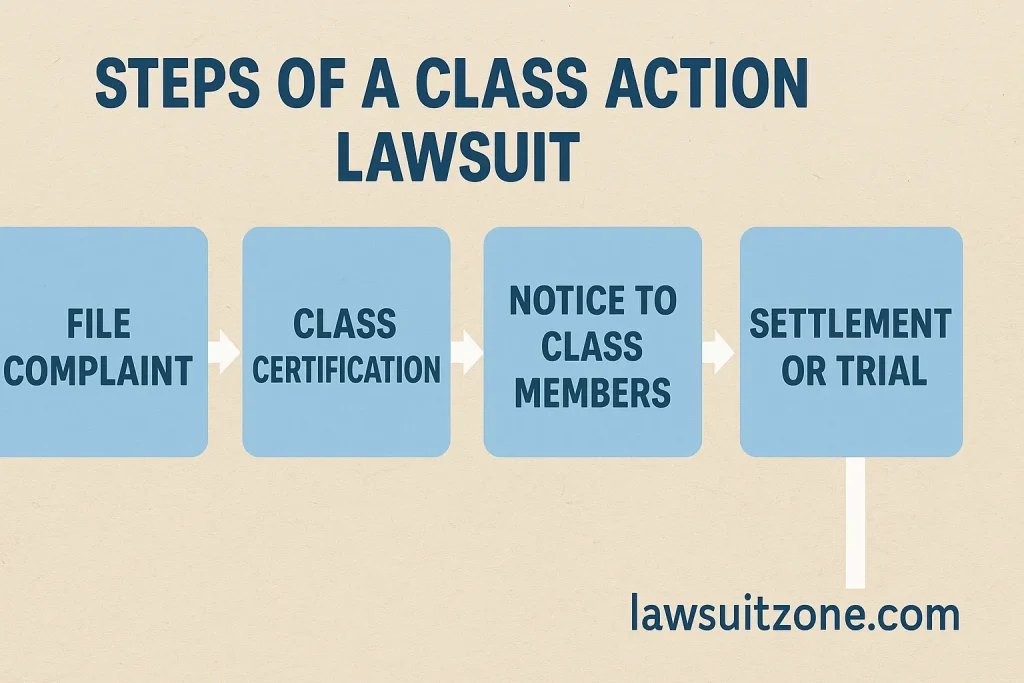
Filing the Complaint
A lawyer or law firm makes a complaint on behalf of the proposed class. It lists the defendant, the alleged harm, the definition of the class, and the relief demanded.
Class Certification
One of the strongest steps. A court would need to certify the class by considering factors such as:
- Is there a sufficient number of people?
- Do they have similar legal or factual questions?
- Is the representative claim typical of the class?
- Can the representative and the lawyers adequately and fairly represent the group’s interests?
If the court does not certify the case, it may fall apart or go back to individual suits.
Notice to Class Members
Once certified, you will be notified about the claim, your rights (stay in, opt out), deadlines, and how you may recover.
Settlement or Trial
Following certification, litigation continues with discovery (gathering of evidence), motions, potential settlement negotiations, or a complete trial. Numerous class action lawsuit California cases resolve by settlement, not trial.
Distribution of Relief
If a settlement or judgment is accepted, a system is established to make payments or other relief to class members. You might be asked to file a claim form. If you opted out, you still have the right to sue individually.
Common Types of Class Action Lawsuits in California
Standard types are:
- Consumer fraud or defective products (where numerous buyers experience equivalent losses)
- Employment class actions (such as wage & hour violations impacting numerous employees)
- Environmental or mass-tort class actions (community damage caused by a big polluter)
- Antitrust or price-fixing suits affecting numerous consumers
These are the most common areas in which class action lawsuit California cases occur.
California Law vs Federal Law
In California, the primary state statute governs how to bring a class action. But numerous cases apply federal law too if the defendant has crossed state lines or raised federal claims. It is worth knowing the interaction between state and federal rules when you hear of a class action lawsuit California, since the process, jurisdiction, and timeframes might vary.
What Happens When You Are in the Class
If you are a part of a class action lawsuit California:
- You’ll be sent notice of your rights.
- You can remain in the class and assert your share when relief is provided.
- You can exclude yourself by deadline if you prefer to have your own claim apart from the class.
- If you remain in and the class wins or settles, you share in the benefit; if you remain in and the case loses, you’re bound by that result.
Grasping these decisions is essential to your rights.
Advantages and Disadvantages
Advantages
- You may receive justice you could not achieve on your own.
- The cost of litigation is shared.
- It sends a message to big corporations: you’re responsible.
Disadvantages
- You waive your right to sue individually for the same cause of action if you remain.
- The settlement amount per individual may be modest.
- The process may be slow and cumbersome.
Therefore, even though a class action lawsuit California can be effective, it is not necessarily the best solution for each claimant.
How to Improve Your Odds of Recovering in a Class Action
- Keep records: receipts, communications, agreements, evidence of injury.
- Verify that the class definition actually applies to your case.
- Carefully read all notices and deadlines when you receive them.
- Consult an attorney who specializes in California class actions.
- Stay up to date on settlement developments and distribution methods.
For overall information on mass legal claims and class procedures, visit the American Bar Association resources.
Misconceptions About These Lawsuits
- Myth: “Suing in a class action is sure to bring big money.”
Reality: Few get big payoffs; many get small sums. - Myth: “If there’s a class action, everybody gets paid automatically.”
Reality: You usually have to file a claim and meet the requirements. - Myth: “Anybody who was hurt can join any class.”
Reality: You have to meet the class definition and the court’s requirements.
Clarifying these gives you realistic expectations when you consider a class action lawsuit California.
Trends Emerging in California Class Actions
- Employment of arbitration provisions and class-waiver terms by corporations to elude class actions.
- Acceleration of digital-privacy class actions with data abuse growing.
- Expansion of environmental and consumer class actions linked with climate, technology, and mass-harm incidents.
These trends determine how future class actions in California will operate and claimants’ potential rights.
What to Do If You Believe You Qualify
- Check if a lot of people are harmed by the same defendant.
- Look for a notice titled “You may be a member of a class action lawsuit California.”
- Read the notice attentively: deadlines, claim forms, joining or opting out options.
- Make your decision based on your own case.
- Keep an eye on the settlement/distribution and act accordingly.
However, not all settlements are widely publicized, and many people miss out simply because they don’t realize they qualify. In some cases, you may already be eligible for compensation through active class action settlements, making it worthwhile to stay informed about potential claims.
After Settlement or Judgment

When the case is over:
- The court ratifies the settlement and release of claims.
- You might need to fill out a claim form.
- Compensation or other relief is disbursed to class members.
- If you opted out, you can still pursue your own separate case.
- If the class loses or is decertified, you could lose the opportunity for a group remedy.
Understanding the timeline and mechanics sets you up better in a class action lawsuit California.
FAQ Highlights
- How many individuals are required? There is no magic number, but the class needs to be sufficiently large that individual suits are not practical.
- Can I initiate one myself? Possible, but typically best left to seasoned class-action attorneys.
- Can the defendant halt it? They can contest certification, but they can’t bar the class device altogether if the court certifies it.
- How long does it take? Frequently years—from complaint to ultimate distribution—particularly in larger cases.
- Does remaining in avoid other lawsuits? Yes—if you remain, you waive the right to sue individually for the same grievance.
The Bigger Picture: Justice, Power & Collective Rights
A class action lawsuit California is not only a legal tool—it’s an expression of society’s desire for group enforcement and responsibility. It means that when lots of people are injured similarly, there needs to be a way to access justice collectively. If your case fits, this vehicle provides an opportunity to be heard and to obtain relief that may otherwise be unavailable.
For Professionals and Creators: Take a Lesson From It
If you have a business, freelance, or hire others—learn from this. Fair play, open operations, and solid documentation aren’t altruistic—they’re risk management. See what happens when groups organize to enforce rights (such as in a class action lawsuit California) and how it can inform managing your own obligations and exposures.
What’s Next?
Anticipate California class action litigation to continue adapting. As business moves in and out of traditional domains, technology improves and expectations shift, group claims will follow. For plaintiffs, paying attention to new categories of harm is prudent. For companies, adapting to these changes is essential.
Final Thoughts
Knowing a class action lawsuit California gives you power if you feel you’ve been part of a group wrong. It opens a door to community justice, with benefits and obligations.
If you choose to proceed: document your injury, assess the definition of the class, record all communications, and adhere to deadlines. While there’s no promise of a big windfall, the potential to join forces with others is real and worthwhile.
In the end, collective legal claims remind us that unity matters. If enough people are harmed the same way, the law offers a voice to many. Use it wisely.
Disclaimer: This article is for informational purposes only and does not make any legal claims or provide legal advice. The details discussed are based on publicly available information about the Juul class action lawsuit.