Sierra Mist Lawsuit Update: Claims, Facts & Key Insights in 2025
Introduction
The Sierra Mist lawsuit has captivated significant attention from consumers, marketing professionals, and drink enthusiasts alike. For several years, Sierra Mist was perhaps the most recognizable lemon-lime soda in America — recognized for its sharp taste, natural imagery, and sunny branding.
But the controversy shifted when the product was unceremoniously phased out and replaced by another beverage. With it came a maelstrom of rumors, blog posts, and reports of impending lawsuits over trademark infringement and false advertising.
This article provides an in-depth, objective analysis of the Sierra Mist lawsuit — from its inception to where it stands today — and looks at what it says about companies and consumers in today’s branding age. Have you checked our detailed guide on hexclad lawsuit.
What Is the Sierra Mist Lawsuit?
Sierra Mist lawsuit is an assortment of consumer and trademark grievances related to the discontinuation and rebranding of the Sierra Mist drink. The key issue is based on two main questions:
- Did the firm’s marketing deceive consumers regarding the ingredients and image of the product?
- Was there a legal dispute over the term “Sierra Mist,” leading to the brand’s hasty withdrawal?
The outcry started when customers saw the product vanishing from the shelves. Shortly thereafter, a social-media argument surfaced asserting that a trademark issue compelled the company to abandon the name. Whether or not the assertions are viable in court, they catalyzed a larger debate about how large companies approach branding, disclosure, and customer communication.
The Rise and Legacy of Sierra Mist
Sierra Mist was launched in the late 1990s as a head-to-head competitor to other lemon-lime colas. Its advertising emphasized freshness, natural taste, and simplicity — frequently employing mountain imagery to suggest purity. It has had various formula and packaging reforms over the years, such as low-sugar and stevia-sweetened variants.
The soda found its way into the arteries of fast-food chains, vending machines, and grocery store shelves. Its marketing focused on “crisp taste” and “all-natural ingredients,” themes that fostered decades of consumer confidence.
But in 2023, enthusiasts were left in shock when the company announced the phasing out of Sierra Mist and the introduction of a new replacement soda. That’s when rumors — and ultimately, legal tension — set in.
Why Did the Lawsuit Happen?
No single reason exists for the Sierra Mist lawsuit. Rather, it resulted from a mix of branding, legal, and consumer-perception problems. The following are the main contributing factors:
1. Trademark Confusion
Rumors spread online that a trademark battle over the name “Sierra Mist” prompted the company to rebrand. Trademark battles happen when two names sound alike or share market identity. A lawsuit never even went anywhere, but such a battle could pressure a firm to move pre-emptively in order to prevent future lawsuits.
2. Suspected Misleading Marketing
A second significant element includes claims that Sierra Mist was promoted as being more natural or healthier than other sodas, despite its being composed of similar ingredients. The thrust of the claim in this case was not so much physical injury but disparity between brand slogan and composition.
3. Sudden Discontinuation and Consumer Confusion
When Sierra Mist disappeared from shelves and a replacement soda emerged without explanation, consumers felt deceived. Most suspected the discontinuation was due to secret legal problems. Not being told otherwise created the perception that more was being covered up — the classic catalyst for consumer revolt.
Key Legal Allegations
The lawsuits and consumer complaints against Sierra Mist revolve around three primary allegations:
- False Advertising: Assertions that promotional messages misled people about the character of the product.
- Trademark Dispute: Issues regarding ownership and name rights of “Sierra Mist.”
- Unfair Business Practices: Contentions that consumers weren’t properly notified prior to the product being withdrawn and substituted.
Although each of these is still open to legal interpretation, collectively they have created an image of doubt and distrust that corporations can no longer afford to overlook.
Timeline of the Sierra Mist Controversy
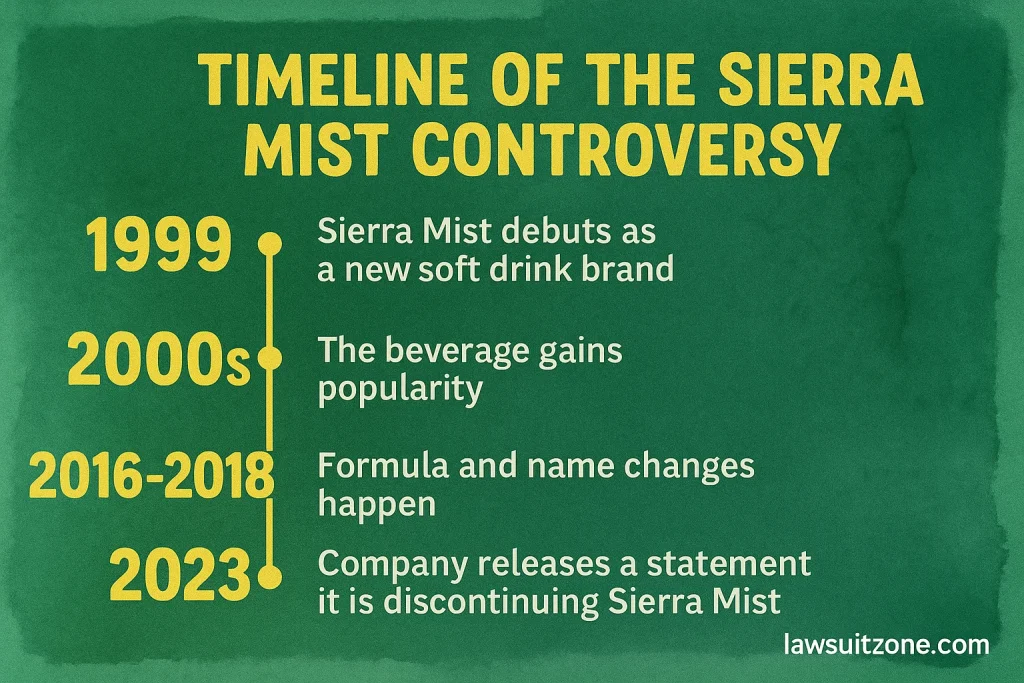
- 1999: Sierra Mist debuts as a new lemon-lime soft drink brand.
- 2000s: The beverage gains popularity across the country, established as a natural option.
- 2016–2018: Formula and name changes take place, temporarily renaming the product “Mist Twst.”
- 2022: Public debate about potential trademark conflict starts circulating online.
- 2023: The firm releases a statement that it is discontinuing Sierra Mist and is launching a new drink.
- 2024–2025: Consumers and legal experts remain arguing over whether or not the discontinuation was business-related or legally driven.
The company itself asserts the switch was simply strategic, yet the public remains skeptical.
Who Could Be Eligible for Compensation?
Should the Sierra Mist lawsuit develop into an approved class-action suit, potential participants might be:
- Consumers who bought the product throughout the challenged marketing period.
- Those who were misled by “natural” or “clean” labeling.
- Retailers or distributors who suffered losses due to the abrupt cutoff.
But until a court formally certifies a class, consumers can’t recover at this point.
What Kind of Compensation Could Be Expected?
Should the case result in a settlement or judgment, the following results are common in such lawsuits:
- Refunds: Consumers might receive modest payments per qualifying purchase.
- Vouchers or Credits: Some settlements provide product credits for use in subsequent purchases.
- Labeling Reforms: The firm may be compelled to explain or modify advertisement statements.
- Public Transparency: Companies occasionally release declarations or reports pledging better advertisement standards.
The general aim is not just financial retribution but to compel ethical marketing and responsibility.
The Company’s Response
The drink manufacturer behind Sierra Mist has repeatedly refuted any misconduct. It claims that the cancellation was due to a brand modernization program and that the product conformed to all food and beverage safety standards.
Executives point out that the move to introduce a new soda was a strategic marketing decision to bring in new consumers who are younger. There was, they maintain, no formal court order or trademark judgment compelling them to change their name.
Nevertheless, the silence on some of the speculations by the company only helped fuel online discussion — underlining how corporate messaging can greatly affect public confidence.
Why the Sierra Mist Lawsuit Matters
Aside from the instant brouhaha, the Sierra Mist case raises larger questions of corporate conscience, advertising, and consumer protection.
For Consumers
It reminds consumers to be more than headline readers. Slogans such as “natural,” “clean,” or “healthy” are marketing jargon more than substantiated claims.
For Companies
It’s a reminder that reputation can be tarnished if openness is absent. Clear information generates trust; silence gives rise to suspicion.
For Regulators
It underscores increasing demand for more transparent advertising regulations in sectors such as food and beverage, where perception trumps fact.
Lessons from the Case
The Sierra Mist lawsuit offers important takeaways to all the players:
- Transparency Wins: When companies speak candidly, they steer clear of public outrage.
- Marketing Must Match Reality: Purity or safety claims must be backed by facts.
- Consumers Are Powerful: Consumer vigilance and action in the age of information can influence corporate policy.
- Legal Preparedness Matters: Firms need to regularly inspect trademarks, ingredient origin, and labeling correctness to avoid controversy.
Myths and Clarifications
Myth 1: Sierra Mist was banned by the government.
Fact: The company voluntarily withdrew the product, did not ban or recall it.
Myth 2: The firm lost a court case.
Fact: To date, no ultimate judgment or official court ruling has found the company to be guilty of wrongdoing.
Myth 3: The new soda is made with the same formula under a different name.
Fact: Formulas tend to differ in order to fit new marketing trends, although similarities can be found.
Myth 4: Consumers are unable to do anything.
Fact: Consumers are able to remain educated, record purchases, and monitor class-action announcements.
Wider Impact on the Soft Drink Industry
The Sierra Mist lawsuit has become the buzz on the beverage and marketing scenes. It sends a message that:
- Brand promises bind in the court of public opinion.
- Transparency is no longer optional in today’s marketing.
- Consumer expectations are greater than ever — particularly in an age of social media.
This case has the potential to reform how beverage businesses promote ingredient transparency, brand changes, and advertising truthfulness.
Expert Insight: Consumer Transparency
It’s the job of companies, says The Federal Trade Commission (FTC), to make sure marketing of products does not misinform consumers regarding health, makeup, or origin. You can find these official consumer-protection guidelines on the FTC website.
This government website gives vetted guidance regarding how firms can steer clear of misleading advertising and how consumers can spot valid product statements.
Frequently Asked Questions (FAQs)
Final Thoughts
The Sierra Mist lawsuit is not just a brand controversy — it’s a sign of the shifting dynamic between consumers and corporations. Whether the allegations result in court rulings or die on the vine as rumor, the lesson holds: trust is the true capital of contemporary business.
For consumers, it emphasizes the worth of awareness and skepticism. For brands, it’s evidence that every statement on a label has legal and ethical consequence.
Ultimately, the Sierra Mist tale isn’t about soda — it’s about the strength of honesty in advertising and the increasing expectation that businesses follow through on what they say.
Disclaimer
The information in this article is for educational and informational purposes only. This article is not legal advice. In all matters relating to a specific legal issue, seek professional advice.