Ohm’s Law Cartoon A Simple Visual Explanation 2026
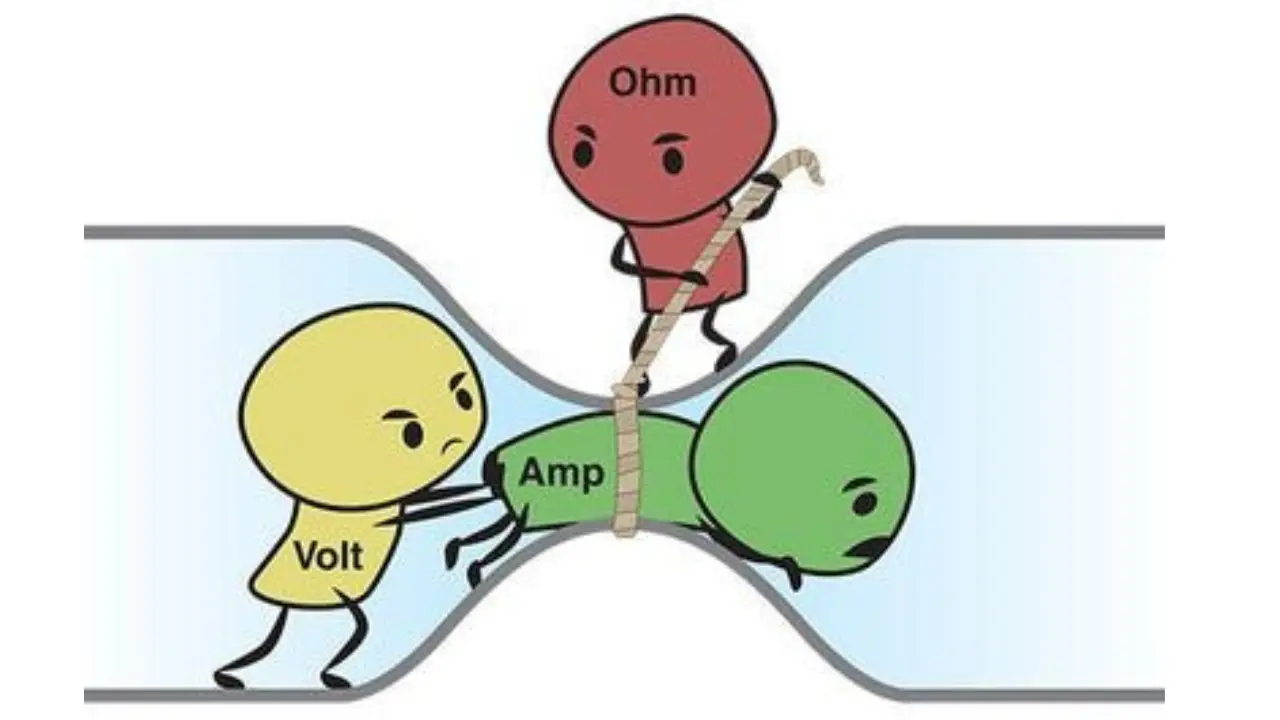
An ohm’s law cartoon is a visual teaching aid that turns an electrical equation into an easy-to-picture story. Most cartoons show electricity as water moving through a pipe: voltage acts like pressure, current is the flow, and resistance is a narrow section that makes flow harder. This picture isn’t a literal model of electricity, but it can make the relationship in Ohm’s law much easier to understand.
Ohm’s law states that current increases when voltage increases and decreases when resistance increases, as long as the other quantity stays the same. It is usually written as V = I × R.
What an Ohm’s law cartoon is showing
An Ohm’s law cartoon commonly gives the three electrical quantities characters or familiar physical forms. A battery may look like a pump, charges may be drawn as moving dots, and a resistor may appear as a blocked, narrow, or rough path. The goal is to show cause and effect rather than to show the microscopic structure of a circuit.
| Electrical quantity | Symbol and unit | Common cartoon or water analogy |
|---|---|---|
| Voltage | V, volts (V) | Pressure difference or a pump pushing water |
| Current | I, amperes (A) | The amount of water flowing per second |
| Resistance | R, ohms (Ω) | A narrow, rough, or partly blocked pipe |
Ohm’s Law Cartoon, In a simple circuit, voltage provides the electrical push, current is the movement of electric charge, and resistance opposes that movement. A cartoon makes the basic pattern visible: more push tends to create more flow, while more opposition tends to reduce it.
The formula behind the picture
Ohm’s Law Cartoon, Ohm’s law connects voltage, current, and resistance:
V = I × R
From this equation, the two other useful forms are:
- I = V ÷ R — current equals voltage divided by resistance.
- R = V ÷ I — resistance equals voltage divided by current.
The law applies to an ohmic component when its resistance stays constant under the conditions being considered. Many basic resistors behave approximately this way over a suitable range. Some components, such as lamps, diodes, and many electronic devices, do not keep a constant resistance in all conditions, so their current-voltage behavior is more complicated.
How to read the water-pipe analogy
The water analogy is one of the most common forms of an Ohm’s law cartoon because it gives each part of the equation an everyday counterpart.
Voltage is like pressure difference
Water flows when there is a pressure difference between two points. Likewise, electric current in a circuit is driven by an electrical potential difference, or voltage. A battery maintains a voltage difference between its terminals, which can drive charge through a complete circuit.
More voltage is like a stronger push. If resistance does not change, raising the voltage raises the current.
Current is like the rate of flow
Ohm’s Law Cartoon, Current measures how much electric charge passes a point each second. In the analogy, it resembles the amount of water passing through a section of pipe each second. It is measured in amperes, often called amps.
A larger current does not mean individual electrons race around a circuit in the same way that water shoots through a pipe. The analogy is mainly about the relationship among quantities, not a perfect physical match.
Resistance is like a restriction
Ohm’s Law Cartoon, A narrower pipe, a partly closed valve, or a rough section of pipe makes water flow more difficult. In a circuit, a resistor or other component can oppose current. Higher resistance means less current for the same voltage.
Resistance is measured in ohms, represented by the Greek symbol Ω. A component with 10 Ω of resistance opposes current less than one with 1,000 Ω, assuming comparable conditions.
Three cartoon scenarios that explain Ohm’s law
Ohm’s Law Cartoon, A good visual usually changes one quantity at a time. That is the key to seeing what the equation means.
More voltage, same resistance
Imagine the same pipe with a stronger pump. The pressure difference rises, so more water flows. In electrical terms, if resistance stays fixed, increasing voltage increases current.
For example, a 6 V source connected to a 3 Ω resistor gives:
I = V ÷ R = 6 ÷ 3 = 2 A
If the source becomes 12 V while the resistor remains 3 Ω, the current becomes 4 A. Doubling the voltage doubles the current.
More resistance, same voltage
Ohm’s Law Cartoon, Now keep the pump unchanged but make the pipe narrower. The restriction reduces the flow. In a circuit, if voltage stays fixed, increasing resistance reduces current.
Using a 12 V source, a 3 Ω resistor allows 4 A in the ideal calculation. Replacing it with a 6 Ω resistor gives:
I = 12 ÷ 6 = 2 A
Doubling resistance halves the current.
More current requires a change elsewhere
A cartoon may show more water moving through a pipe, but current is not usually adjusted by itself. To increase current in a simple circuit, increase voltage, reduce resistance, or do both. The equation helps identify which change is needed.
Using the Ohm’s law wheel or triangle
Ohm’s Law Cartoon, Many classroom cartoons include an Ohm’s law wheel or triangle. It places V at the top and I and R below it. Cover the quantity you want to find: the remaining layout suggests the calculation.
- Cover V: multiply I by R.
- Cover I: divide V by R.
- Cover R: divide V by I.
This is a memory device, not a separate scientific rule. Understanding the original equation is more reliable, especially when working with units or more complex circuits.
What the cartoon gets right—and where it can mislead
Ohm’s Law Cartoon, The pipe picture helps begin calculations, but electricity is not water. Treat it as a limited model.
Useful parts of the analogy
- It shows that a difference in potential drives flow.
- It makes clear why greater opposition reduces flow.
- It helps explain why a complete path is needed for steady current.
- It supports the proportional relationships in V = I × R.
Important limits
- Electrical charge is not consumed by a resistor. In a basic series circuit, the current is the same through each component.
- A battery does not simply “send out electrons” that disappear at the load. It maintains an electric potential difference that causes charges already present in the circuit to move.
- Voltage is not exactly pressure. The comparison is useful, but voltage is energy transferred per unit charge.
- Real circuits can include changing currents, capacitance, inductance, heat effects, and non-ohmic components that a simple pipe drawing does not capture.
How to make a clear Ohm’s law cartoon
Ohm’s Law Cartoon,For a school poster, worksheet, or presentation, use one circuit idea and keep the labels direct. The drawing should support the equation instead of competing with it.
- Draw a simple closed loop, or draw a water pipe as a clearly labeled analogy.
- Add a battery or pump and label it voltage (V).
- Add arrows or moving dots to show current (I).
- Add a resistor, narrow section, or valve and label it resistance (R).
- Place V = I × R beside the drawing.
- Create two small comparison panels: one with higher voltage and one with higher resistance.
- Add a short note that the water model is an analogy, not the actual behavior of electrons.
Worked examples a cartoon can illustrate
Ohm’s Law Cartoon, Short numerical examples give a visual explanation of practical value. Keep the units visible throughout the calculation.
Finding current
A 9 V battery is connected to a 3 Ω resistor.
I = V ÷ R = 9 V ÷ 3 Ω = 3 A
A cartoon could show a moderate pump pressure, a fairly open pipe, and three current arrows.
Finding resistance
A circuit has 2 A of current and a 10 V potential difference.
R = V ÷ I = 10 V ÷ 2 A = 5 Ω
The visual message is that a 5 Ω restriction produces the observed current at that voltage.
Finding voltage
A 4 Ω resistor carries 1.5 A of current.
V = I × R = 1.5 A × 4 Ω = 6 V
The source must provide 6 V across that resistor under the assumptions of Ohm’s law.
Frequently asked questions
What is the easiest way to explain Ohm’s law?
Explain it as a relationship: voltage pushes charge, resistance opposes its movement, and current is the resulting flow. Then use V = I × R with one simple example.
Why is a water analogy used for electricity?
Water flow gives a familiar picture of pressure, flow rate, and restriction. Those ideas resemble voltage, current, and resistance well enough for an introductory explanation, even though the two systems are not identical.
Does higher voltage always mean higher current?
Higher voltage produces higher current only when resistance stays the same and the component behaves approximately according to Ohm’s law. Changing resistance or using a non-ohmic component can change the result.
Does resistance stop current completely?
Finite resistance limits current; it does not necessarily stop it. An open circuit, which has no complete conducting path, prevents steady current from flowing through that path.
What does the Ω symbol mean?
Ω is the symbol for the ohm, the unit of electrical resistance. It is named after Georg Simon Ohm, whose work led to the law bearing his name.
A visual starting point, not the whole theory
An ohm’s law cartoon works best as a first step: it makes the relationship among voltage, current, and resistance memorable, then the equation confirms it with numbers. Use the water-pipe image to understand the direction of change, but remember its limits. In a real circuit, charge is conserved, voltage is a potential difference, and some components do not follow a constant-resistance model.