
Virginia Law on Eviction Without a Lease Rules 2026
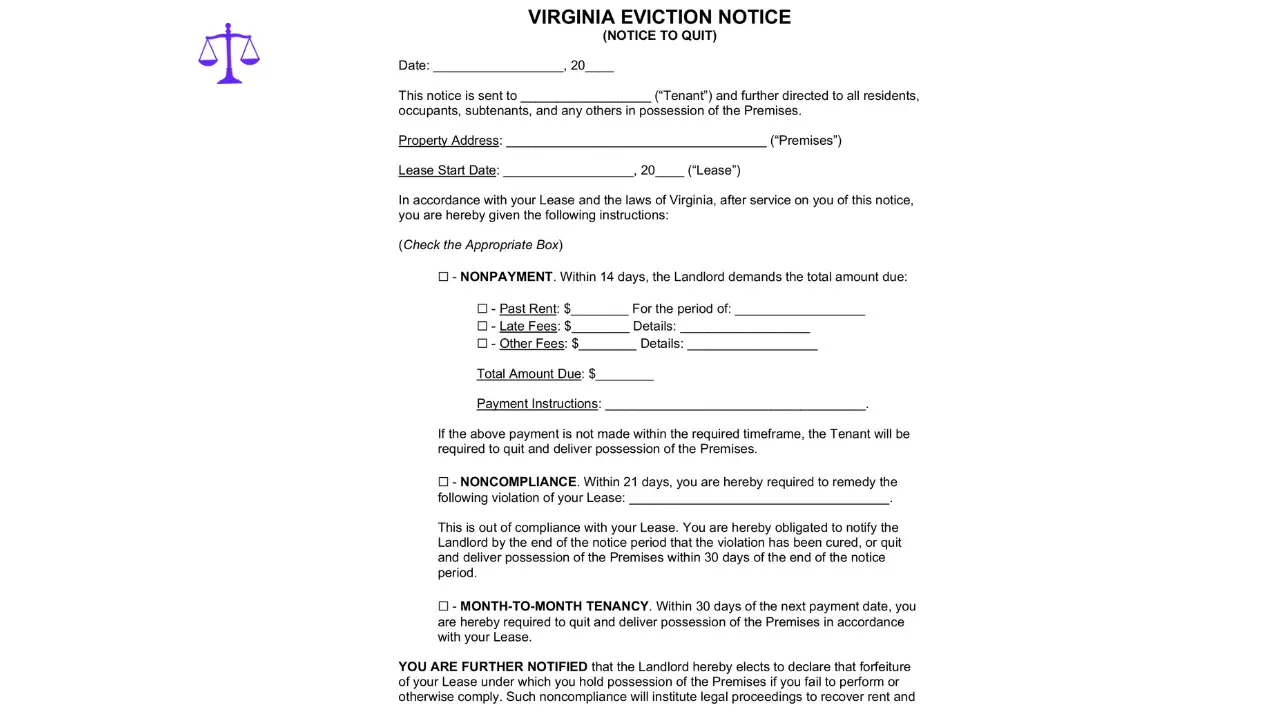
Virginia law on eviction without a lease does not allow a landlord to simply change the locks or remove a person because there is no signed written contract. A rental arrangement can still exist through an oral agreement or the parties’ conduct, such as when a person pays rent and the owner accepts it. In many situations, Virginia treats that arrangement as a month-to-month tenancy. The landlord generally must give the legally required notice, file an unlawful detainer case if the person does not leave, obtain a court judgment, and have law enforcement carry out any physical eviction.
Does Virginia Law on Eviction Without a Lease?
Virginia Law on Eviction Without a Lease, Yes. A written lease is not the only way to create a landlord-tenant relationship in Virginia. An oral agreement to rent a home may be enforceable, and a tenancy can also arise when an owner permits someone to occupy a dwelling in exchange for rent.
Under the Virginia Residential Landlord and Tenant Act, a rental agreement may be written or oral. When the agreement does not state a fixed term, Virginia law generally treats the tenancy as month-to-month if rent is paid monthly. The exact arrangement can matter: evidence about the agreed rent, payment schedule, utilities, occupancy permission, and communications between the parties may help show whether a tenancy exists.
Virginia law on eviction without a lease: the basic rule
Even without a written lease, a landlord ordinarily must use the legal eviction process to recover possession from a tenant. The landlord cannot use self-help measures, such as locking out a tenant, removing belongings, or shutting off essential services, to force the tenant out.
The correct notice and timing depend on why the landlord wants the tenancy to end. Common reasons include ending a month-to-month tenancy without alleging a breach, nonpayment of rent, or a material violation of the rental agreement. After proper notice expires, the landlord may file an unlawful detainer action if the occupant remains.
Ending a month-to-month tenancy
For a typical month-to-month residential tenancy, Virginia Code § 55.1-1253 generally requires written notice at least 30 days before the next rent-due date to terminate the tenancy. In practical terms, the notice must give the tenant the required lead time before the rental period ends.
For example, if rent is due on the first day of each month, the timing of delivery can affect whether a termination can take effect at the end of the next month or a later rental period. Because calculating notice can be fact-specific, a landlord should not assume that a notice delivered late in a month ends the tenancy at that month’s end.
Nonpayment of rent
Virginia Law on Eviction Without a Lease, If the claimed reason is unpaid rent, a different notice rule generally applies. Under Virginia Code § 55.1-1245, a landlord may generally give a written notice stating that the rental agreement will end if rent is not paid within five days. If the tenant pays the full amount properly due within that period, the tenancy may continue, subject to the circumstances and applicable law.
Other alleged lease violations
An oral tenancy can still have enforceable rules. For many material breaches that can be corrected, Virginia Code § 55.1-1245 generally uses a 21/30-day notice process: the notice identifies the breach, gives 21 days to remedy it, and states that the tenancy will terminate after 30 days if it is not corrected.
Some alleged violations may be treated differently under Virginia law, especially if they are not remediable or involve conduct that creates a serious risk. The facts and statutory requirements matter. A landlord should not treat a disagreement, an unproven accusation, or an informal house rule as automatic grounds for immediate removal.
What happens after the notice period?
Virginia Law on Eviction Without a Lease, If the tenant has not moved out after a valid termination notice expires, the landlord may generally file an unlawful detainer case in the appropriate Virginia General District Court. An unlawful detainer is the court process used to seek possession of property from someone alleged to be unlawfully staying there.
- Notice: The landlord gives the applicable written termination or payment notice.
- Court filing: If the occupant remains, the landlord may file an unlawful detainer case.
- Service and hearing: The occupant must be served with court papers and has a chance to appear and present evidence or defenses.
- Judgment: If the court awards possession to the landlord, the landlord may seek a writ of possession.
- Execution: A sheriff, not the landlord, carries out the physical eviction under the court’s writ.
Self-help eviction is generally prohibited
Virginia Code § 55.1-1243 generally bars a landlord from unlawfully removing or excluding a tenant from the premises or intentionally interrupting essential services to recover possession. This protection is important when there is no written lease because the lack of paperwork does not erase a tenant’s rights.
Examples of conduct that may raise serious legal concerns include changing locks while the tenant is away, blocking entry, removing possessions without a court-authorized eviction, or turning off water, heat, or electricity to make the tenant leave. The facts, the type of occupancy, and any emergency circumstances can matter, but a landlord should use the court process rather than self-help.
Tenant, roommate, guest, and owner-occupant situations
Virginia Law on Eviction Without a Lease, Eviction questions can become more complicated when the owner lives in the same home, when the person renting is a roommate rather than the property owner, or when the occupant never paid rent directly to the owner. The Virginia Residential Landlord and Tenant Act applies to many residential rentals, but not every living arrangement is treated the same way.
Is there a class action or settlement about eviction without a lease in Virginia?
No verified class action or settlement is inherent in the phrase “Virginia law on eviction without a lease.” It describes a general landlord-tenant legal issue, not a specific lawsuit against a named company, landlord, or government agency.
Individual eviction disputes are usually handled based on the specific rental arrangement, notice, and court record. A person should be cautious about advertisements or online posts suggesting that everyone evicted without a written lease is entitled to settlement money. A valid settlement would have identifiable court documents, defined class terms, official notices, and stated deadlines.
What landlords and tenants should keep
Virginia Law on Eviction Without a Lease, Both sides benefit from keeping clear records before an eviction dispute reaches court. Written documentation can help clarify whether there was a rental agreement and whether the required notices were given.
- Proof of rent payments or amounts allegedly unpaid
- Copies of all notices and proof of delivery
- Text messages, emails, and letters about the occupancy
- Any oral-agreement terms written down by either party at the time
- Photos or inspection records relevant to claimed property damage or conditions
- Court papers, hearing notices, and any judgment or writ issued by the court
Current status of Virginia law on eviction without a lease
Virginia Law on Eviction Without a Lease, The current legal issue is governed by Virginia landlord-tenant statutes and court procedures, rather than a single pending lawsuit or verified settlement. The general rule remains that a residential tenant without a written lease may still have a legally recognized tenancy and is ordinarily entitled to notice and court process before eviction.
Frequently asked questions
Can a landlord evict someone in Virginia if there is no lease?
Yes, but the lack of a written lease does not usually permit an immediate removal. If a tenancy exists, the landlord generally must give the required notice and use the unlawful detainer court process if the tenant does not leave.
How much notice is required for a month-to-month tenant in Virginia?
Virginia Code § 55.1-1253 generally requires 30 days’ written notice before the next rent-due date to terminate a month-to-month residential tenancy. The exact effective date depends on the rent schedule and when notice is delivered.
Can a landlord change the locks on a tenant without a lease?
Generally, no. Virginia law generally prohibits a landlord from excluding a tenant or interrupting essential services to recover possession without using the legal process.
What if the tenant does not pay rent?
A landlord may generally use a written five-day notice for nonpayment under Virginia Code § 55.1-1245 before filing an eviction case. The amount due, payment history, and proper delivery of the notice can be disputed in court.
Is a person who stays at a home a tenant or a guest?
It depends on the facts. Regular rent payments, permission to live there, possession of a room or home, receipt of mail, and the length and nature of the arrangement may be relevant. Labels alone do not control.
Is there a settlement for eviction without a lease in Virginia?
No general, verified settlement applies simply because a person was involved in an eviction dispute without a written lease. Any actual settlement would need to be verified through official court or settlement materials.
Conclusion
Virginia law on eviction without a lease generally recognizes that an oral or month-to-month rental arrangement can create real tenant rights and duties. A landlord may be able to end that tenancy, seek unpaid rent, or pursue an eviction for a legally supported reason, but must generally provide the applicable notice and obtain a court order before a sheriff carries out removal. There is no general class action or verified settlement tied to this legal topic. The outcome of any individual dispute depends on the parties’ agreement, payment and notice records, and the applicable Virginia law.