Camp Lejeune Settlements: A Complete Guide for Families Seeking Justice
Introduction
For many thousands of veterans and military families, the Camp Lejeune settlements are no longer purely a legal issue; rather, it is a personal fight for acknowledgment and justice. For more than three decades, people living and working at Marine Corps Base Camp Lejeune were unknowingly exposed to hazardous toxins in their drinking water. Many went on to develop cancers, neurological disorders, birth complications, and chronic illnesses that would change their lives forever.
Decades have passed with survivors seeking answers and accountability. Today, thanks to the CLJA, the victims will finally have a clear avenue toward compensation. This is a comprehensive guide on how these settlements work, who qualifies, how the payouts will be calculated, and what steps a family should take now. Whether you are a veteran, a spouse, a child who grew up on the base, or an advocate for a loved one, this article will break it all down in clear, human terms. Have you checked our detailed guide on baby formula lawsuit.
What Are Camp Lejeune Settlements?
Camp Lejeune settlements refer to the monetary compensation designed to help individuals who suffered due to exposure to toxic water at the Marine Corps base in North Carolina from 1953 to 1987. The CLJA has paved the way for victims to have the right to file claims directly against the U.S. government for such payments.
Before this law took effect, victims were dismissed due to strict immunity rules that barred lawsuits against the military. Many have waited years as their illnesses worsened, families struggled financially, and loved ones died. Now, settlements finally provide the support they deserved decades ago.
These settlements may cover:
- Long-term medical attention
- Cancer treatment
- Lost wages and reduced earning capability
- Disability or permanent impairment
- Pain, suffering, and emotional distress
- Funeral and burial expenses
- Compensation for wrongful death
The aim is straightforward: financial security for families and recognition for the damage resulting from decades of unsafe exposure.
How Did Camp Lejeune’s Water Become Contaminated?
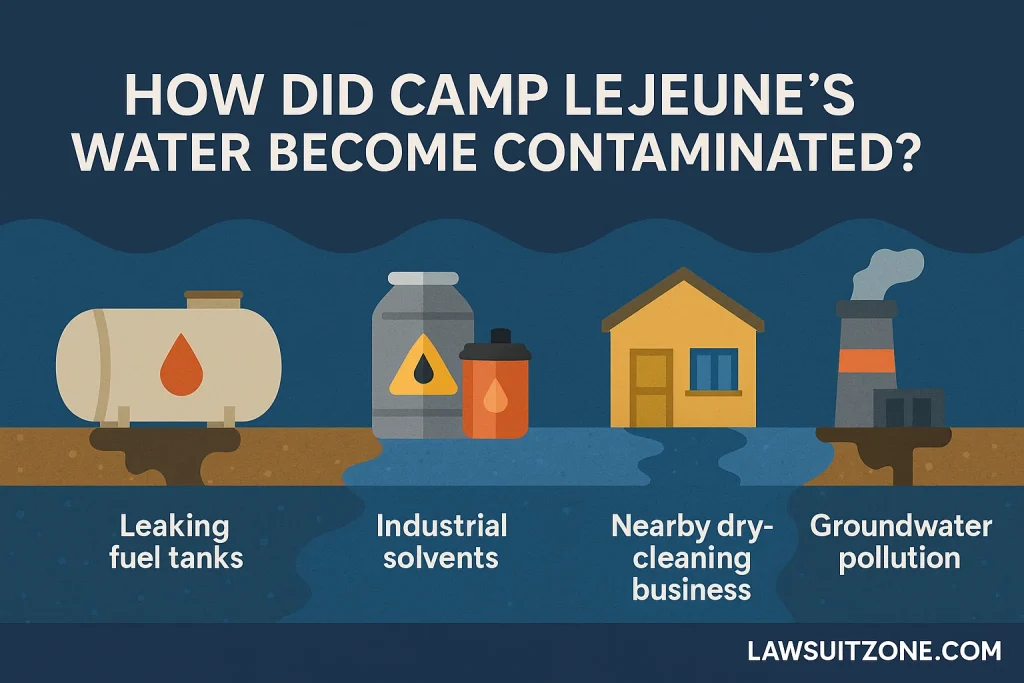
Contamination at Camp Lejeune came from no single source, but it was the result of a catastrophic mix of negligence, industrial waste, bad oversight, and very lax environmental controls.
Major Sources of Toxic Chemicals:
- Leaking fuel tanks under the base
- Industrial solvents for machinery cleaning
- A nearby dry-cleaning business disposing of PCE and other chemicals
- Improper waste disposal practices
- Groundwater contamination from spills and runoff
These dangerous chemicals contaminated wells serving as sources of water to housing units, barracks, hospitals, daycare centers, and family housing units.
Common Chemicals Found in the Water:
- Trichloroethylene (TCE)
- Perchloroethylene (PCE)
- Benzene
- Vinyl chloride
Some of these toxins were found at levels up to 3,400 times higher than what is now considered safe.
This was the daily drinking, cooking, and bathing water for the families, many while pregnant or raising newborns. The exposure was constant, long-term, and far more dangerous than anyone had realized at the time.
Health Conditions Associated With Exposure at Camp Lejeune
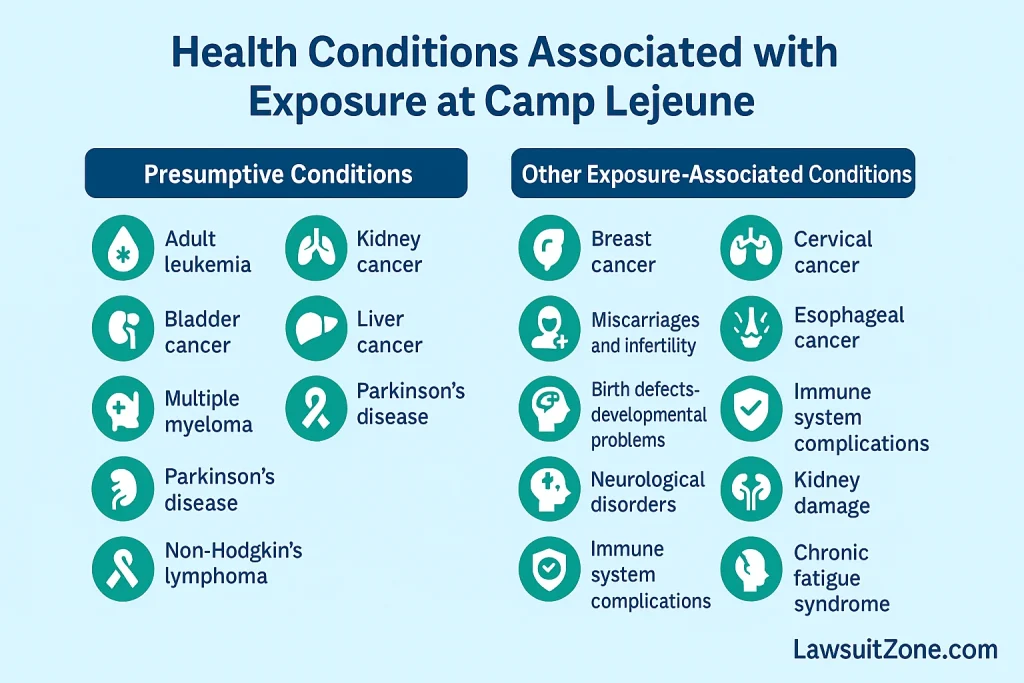
Medical research, federal investigations, and toxicology reports have all linked many illnesses to the base’s contaminated water.
Presumptive Conditions
These diseases are automatically deemed by the government as being related to Camp Lejeune exposure:
- Adult leukemia
- Bladder cancer
- Kidney cancer
- Liver cancer
- Multiple myeloma
- Parkinson’s disease
- Non-Hodgkin’s lymphoma
- Aplastic anemia and related syndromes
Other Exposure-Associated Conditions
Although not “presumptive,” these are strongly associated with chemical exposure:
- Breast cancer
- Cervical cancer
- Lung cancer
- Esophageal cancer
- Miscarriages and infertility
- Birth defects and developmental problems
- Neurological disorders
- Immune system complications
- Kidney damage
- Chronic fatigue syndrome
Years and even decades passed before many victims began to connect their illnesses to Camp Lejeune.
Who Qualifies for Camp Lejeune Settlements?
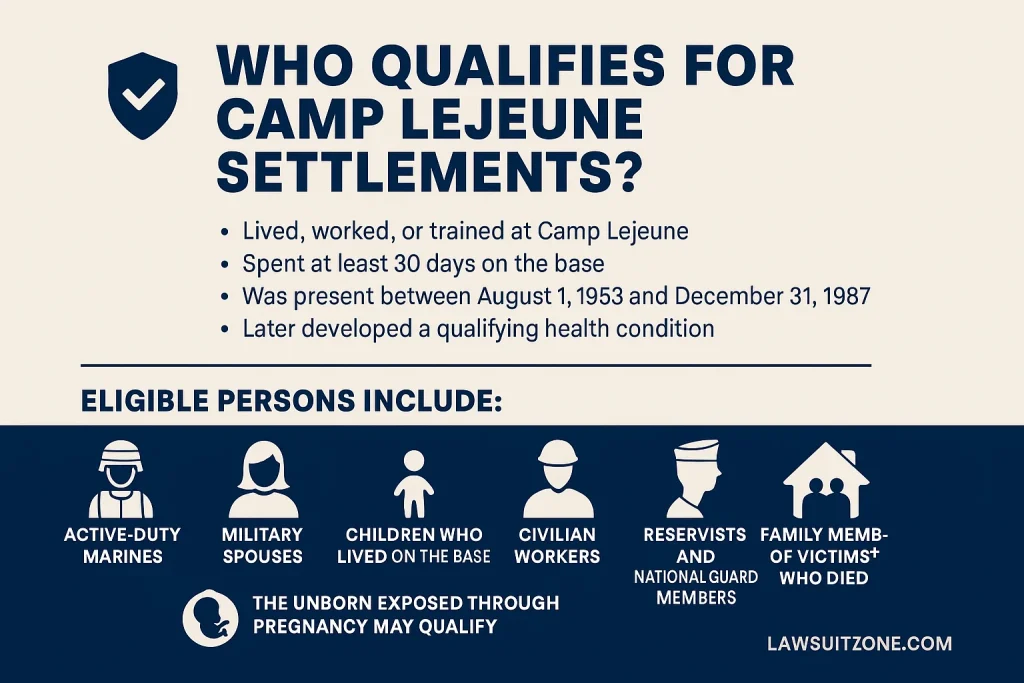
Eligibility is rather broad, allowing compensation for anyone who:
- Lived, worked, or trained at Camp Lejeune
- Spent at least 30 days on the base
- Was present between August 1, 1953 and December 31, 1987
- Later developed a qualifying health condition
Eligible persons include:
- Active-duty Marines
- Military spouses
- Children who lived on the base
- Civilian workers
- Reservists and National Guard members
- Veterans who trained at the base
- Family members of victims who died
Even unborn children exposed through pregnancy may qualify.
Camp Lejeune Settlement Process Explained
The process leading to a settlement involves several steps, each designed to ensure claims are reviewed comprehensively.
Step 1 — File an Administrative Claim
Claims must be submitted to the Tort Claims Unit, Department of the Navy. This is an essential preliminary step before instituting court action.
Step 2 — Government Review Period
The Navy will review your evidence, medical treatment records, and proof of exposure. Additional information may be requested.
Step 3 — Settlement Offer or Denial
If your evidence is strong and your condition is recognized, you may receive a settlement offer.
Step 4 — Filing a Lawsuit (Optional, but Common)
If you do not hear back in 6 months or if the amount is insufficient, you can file in federal court.
Step 5 — Negotiation or Trial
Most cases will settle before going to trial, especially under the government’s new Elective Option, a system designed to speed up the payments.
How Much Money Can Victims Receive?
Settlement amounts vary drastically depending on:
- Age at exposure
- Medical condition
- Treatment costs
- Severity of disability
- Impact on daily life
- Whether death occurred
Estimated Settlement Ranges for Common Conditions
| Illness | Estimated Settlement |
|---|---|
| Parkinson’s disease | $400,000–$1,000,000 |
| Bladder cancer | $200,000–$550,000 |
| Kidney cancer | $150,000–$550,000 |
| Leukemia | $150,000–$450,000 |
| Non-Hodgkin’s lymphoma | $200,000–$600,000 |
| Birth defects | $250,000–$850,000 |
| Wrongful death | $500,000–$1,200,000+ |
These are not guarantees but projections based on similar toxic exposure cases and early CLJA patterns.
Evidence Needed for a Successful Camp Lejeune Claim
The claim becomes strongest when supported by:
1. Proof of Presence
Such as:
- Military orders
- Housing records
- Employment documents
- School or daycare records
- Base medical records
2. Proof of Diagnosis
Including:
- Lab test results
- Pathology reports
- Physician statements
- Treatment records
- Cancer staging records
3. Evidence Linking Illness to Exposure
This may include:
- Toxicology reports
- VA findings
- Expert medical opinions
The stronger your documentation, the higher your potential settlement can be.
Why Camp Lejeune Settlements Are So Important
To many individuals, these settlements mean far more than financial assistance; they are recognition of decades of struggle.
They help families pay for:
- Chemotherapy
- Operations
- Medications
- Mobility equipment
- Home care
- Transportation to medical treatment
- Funeral costs
They provide long-overdue validation:
Many victims faced years of denials and benefit dismissals, while the settlements have finally recognized a connection between exposure and their sufferings.
The U.S. Department of Veterans Affairs issues official guidance, known illnesses, and health care eligibility for victims of Camp Lejeune. You can access their updated information directly at the VA’s official website: https://www.va.gov
Frequently Asked Questions
Final Thoughts
The story of Camp Lejeune settlements is a painful reminder that environmental negligence can go to the very core of human life. For decades, families trusted the water they drank, cooked with, and bathed in, never to realize it carried with it invisible risks which would appear years later.
The Camp Lejeune Justice Act empowers these victims and their families to seek answers, accountability, and compensation. Whether you proudly served as a veteran, supported your family through years of illness as a spouse, or grew up on the base as a child, your story matters. By taking action today, you can secure your health, your finances, and the justice you deserve if you believe you have been harmed.
Disclaimer
This article is intended for information only and should not be considered legal or medical advice. Always consult with a qualified attorney regarding your specific case.