Avogadro’s Law Formula Meaning Equation Examples and Uses
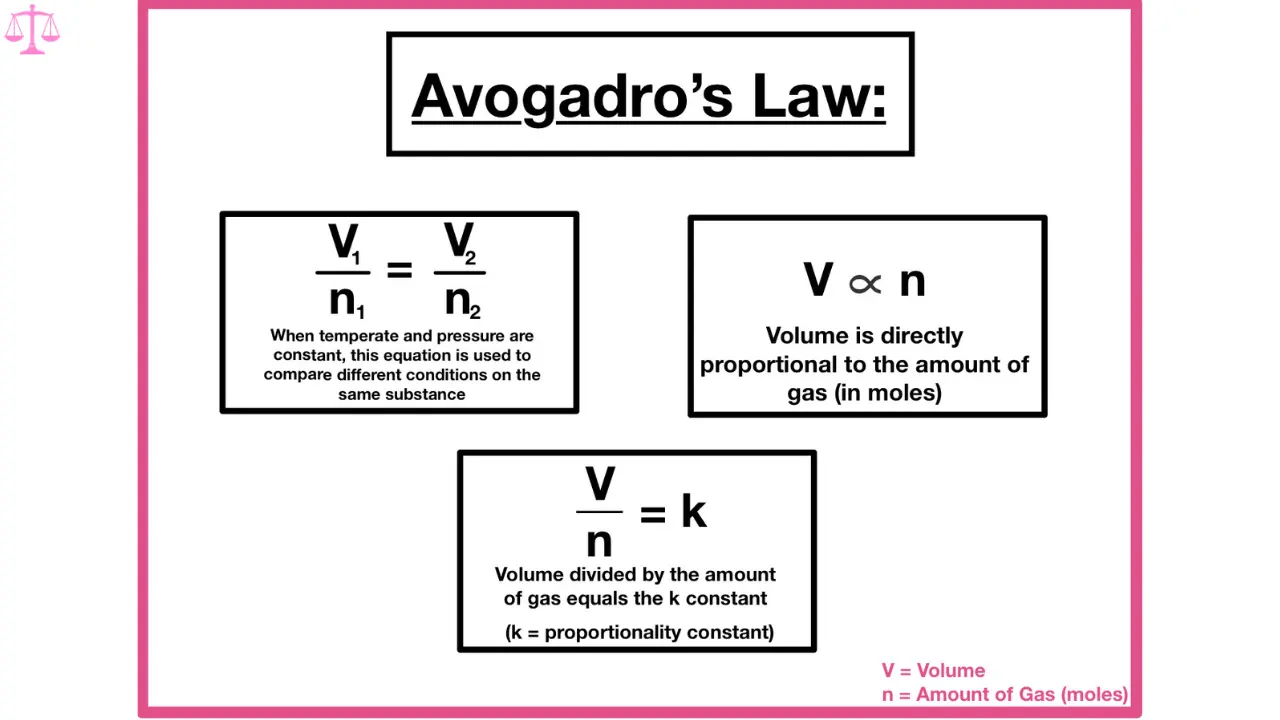
Avogadro’s law formula explains how the volume of a gas changes when the number of gas particles changes. This law applies when pressure and temperature remain constant.
Italian scientist Amedeo Avogadro introduced this important idea in 1811. His work helped scientists understand gases, molecules, and chemical reactions more clearly.
What Is Avogadro’s Law Formula?
Avogadro’s law states that equal volumes of gases contain equal numbers of molecules under the same conditions. Therefore, adding more gas particles increases the total gas volume.
For example, a balloon becomes larger when a person blows more air into it. The pressure and temperature may stay almost stable while the amount of gas increases.
Avogadro’s Law Formula and Equation
The standard Avogadro’s law formula is written as V₁/n₁ = V₂/n₂. In this equation, V means volume, while n represents the number of moles.
Scientists can also write the relationship as V ∝ n. This form means that gas volume remains directly proportional to the amount of gas.
| Symbol | Meaning | Common Unit |
|---|---|---|
| V₁ | Initial gas volume | Litres or millilitres |
| n₁ | Initial number of moles | Moles |
| V₂ | Final gas volume | Litres or millilitres |
| n₂ | Final number of moles | Moles |
Conditions Required for the Law
Scientists can only use this gas law when temperature and pressure remain constant. A change in either condition can affect the volume and produce a different result.
The gas should also behave close to an ideal gas. Most gases follow the law well under normal pressure and moderate temperature conditions.
How the Formula Works
Avogadro’s law formula shows a direct relationship between volume and moles. When the number of moles doubles, the gas volume also doubles.
Likewise, when the number of moles falls by half, the volume falls by half. This pattern makes the equation easy to understand and apply.
Suppose one mole of gas takes up two litres of space. Two moles of the same gas will occupy four litres under identical conditions.
Steps to Solve
First, identify the initial volume, final volume, initial moles, and final moles. Next, place the known values into the correct positions in the equation.
Then, cross-multiply the values and divide to find the missing amount. Finally, include the correct measurement unit in the answer.
The following rearranged equations can help students solve different questions:
| Missing Value | Rearranged Equation |
|---|---|
| Final volume | V₂ = V₁ × n₂ ÷ n₁ |
| Initial volume | V₁ = V₂ × n₁ ÷ n₂ |
| Final moles | n₂ = V₂ × n₁ ÷ V₁ |
| Initial moles | n₁ = V₁ × n₂ ÷ V₂ |
Example Calculation
Imagine that two moles of gas occupy six litres. The amount increases to four moles while temperature and pressure remain unchanged.
Using Avogadro’s law formula, we write 6/2 = V₂/4. After cross-multiplying, the final volume becomes 12 litres.
This result makes sense because the number of moles doubled from two to four. As a result, the gas volume also doubled from six to twelve litres.
Real-Life Examples
A balloon offers a simple example of this law. As more air enters the balloon, the number of gas molecules rises, and the balloon expands.
A bicycle tyre also receives more gas particles during inflation. However, tyre pressure may rise, so the conditions do not always remain perfectly constant.
Airbags also use gas-producing chemical reactions to inflate quickly during a crash. The reaction creates many gas molecules, which rapidly increase the bag’s volume.
Difference Between Avogadro’s Law and Other Gas Laws
Avogadro’s law formula connects gas volume with the number of moles. Boyle’s law connects volume with pressure, while Charles’s law connects volume with temperature.
Each law studies two changing properties while keeping other conditions constant. Together, these laws help explain how gases behave in different situations.
| Gas Law | Main Relationship | Constant Conditions |
|---|---|---|
| Avogadro’s law | Volume and moles | Temperature and pressure |
| Boyle’s law | Pressure and volume | Temperature and moles |
| Charles’s law | Volume and temperature | Pressure and moles |
| Gay-Lussac’s law | Pressure and temperature | Volume and moles |
Importance in Chemistry
Chemists use Avogadro’s Law Formula to calculate gas amounts during chemical reactions. The equation also supports work involving molar volume and gas measurements.
At standard temperature and pressure, one mole of an ideal gas occupies about 22.4 litres. However, this value changes when temperature or pressure changes.
The law also supports the ideal gas equation, written as PV = nRT. This equation combines pressure, volume, temperature, and the number of moles.
Common Mistakes Students Should Avoid
Students sometimes use grams instead of moles in the equation. They must first convert mass into moles by dividing the mass by the molar mass.
Some students also forget that temperature and pressure must remain constant. Without these fixed conditions, Avogadro’s law formula may not give an accurate answer.
Students should use matching volume units on both sides of the equation. For example, they should convert millilitres into litres when the other volume appears in litres.
Avogadro’s Number and Avogadro’s Law
Avogadro’s number equals approximately 6.022 × 10²³ particles per mole. It tells scientists how many atoms, molecules, or particles exist in one mole.
Avogadro’s number and Avogadro’s law relate to the mole concept, but they describe different ideas. The law explains volume changes, while the number counts particles.
For example, one mole of oxygen contains 6.022 × 10²³ oxygen molecules. Two moles contain twice that amount and occupy twice the volume under constant conditions.
Practical Applications
Industries use Avogadro’s law formula when storing, transporting, and measuring gases. Gas companies must understand how particle amounts affect container volume.
Laboratories also use the law during gas collection experiments. Scientists can estimate the number of moles by measuring the gas volume under controlled conditions.
Medical workers apply gas principles when using oxygen cylinders and breathing equipment. Engineers also study these relationships when designing airbags, engines, and ventilation systems.
Conclusion
Avogadro’s law explains that gas volume increases when the number of moles increases. This relationship remains valid when temperature and pressure stay constant.
Avogadro’s law formula is V₁/n₁ = V₂/n₂, and students can use it to solve many gas problems. A clear understanding of this law builds a strong base for chemistry, physics, and laboratory work.