Understanding Asbestos Exposure Laws in New Mexico
When the Environmental Protection Agency banned most asbestos uses in 1989, many Americans assumed the mineral’s threat had ended. Yet according to the Mesothelioma Applied Research Foundation’s 2023 surveillance data, approximately 3,000 people still receive mesothelioma diagnoses annually — with many cases linked to exposures that occurred decades earlier in workplaces and buildings that predate modern safety standards.
New Mexico presents a particularly complex legal landscape for asbestos exposure. The state’s mining heritage, military installations, and older infrastructure create ongoing exposure risks, while a patchwork of federal regulations and state-specific statutes governs everything from workplace safety limits to property disclosure requirements. For residents, workers, and property owners navigating this regulatory maze, understanding how federal and state laws interact has real consequences — whether you’re a contractor handling renovation work, a property buyer concerned about disclosure requirements, or someone facing health effects from past exposure.
The stakes extend far beyond compliance paperwork. New Mexico’s unique position as both a historically mining-intensive state and home to federal facilities means exposure scenarios that might seem straightforward elsewhere often involve multiple overlapping jurisdictions and regulatory frameworks that can determine everything from liability standards to compensation pathways.
How Federal and New Mexico Asbestos Laws Interact
Federal asbestos regulation operates through three primary agencies, each controlling different aspects of exposure risk. The Environmental Protection Agency governs asbestos manufacturing and distribution under the Toxic Substances Control Act, while OSHA sets workplace exposure limits, and the Department of Transportation regulates asbestos transport and disposal. These federal frameworks establish baseline protections that apply universally across all states.
New Mexico builds upon these federal standards through state-specific statutes that address gaps in federal coverage. The state’s Environmental Improvement Act grants the New Mexico Environment Department authority to regulate asbestos abatement activities more stringently than federal minimums require. Where federal law sets a permissible exposure limit of 0.1 fibers per cubic centimeter over an eight-hour workday, New Mexico regulations often require additional protective measures in specific industries like mining and construction.
The interplay becomes particularly complex around enforcement. While OSHA handles workplace violations at private companies, New Mexico’s Occupational Health and Safety Bureau maintains concurrent jurisdiction over state and local government worksites. This dual authority means a municipal building renovation project might face both federal OSHA oversight and state-specific permitting requirements that federal law doesn’t address.
Property transactions represent another area where state law diverges significantly from federal requirements. Federal regulations focus primarily on commercial and industrial properties, but New Mexico’s Property Disclosure Act requires sellers of residential properties built before 1978 to disclose known asbestos-containing materials. This state requirement extends disclosure obligations well beyond what federal law mandates, creating legal responsibilities that many property owners don’t realize exist until a transaction begins.
The practical result is a regulatory environment where compliance requires understanding both systems. A contractor removing asbestos tiles from a school built in the 1960s must navigate federal AHERA requirements for educational facilities, OSHA workplace safety standards, New Mexico’s contractor licensing rules, and potentially local municipal ordinances — each with distinct notification, training, and disposal requirements.
What Are the Occupational Exposure Limits and Safety Standards?
OSHA’s construction standard represents the most stringent federal workplace protection, setting the permissible exposure limit at 0.1 fibers per cubic centimeter averaged over an eight-hour period. This standard applies to any construction work that might disturb asbestos-containing materials, from major renovation projects to routine maintenance that involves drilling or cutting. The regulation requires employers to conduct exposure assessments before work begins and implement specific control measures when exposure might exceed the action level of 0.05 fibers per cubic centimeter.
New Mexico’s approach to workplace protection extends these federal minimums through enhanced training requirements and stricter licensing standards for asbestos workers. The state requires 32 hours of initial training for asbestos abatement supervisors — eight hours beyond the federal minimum — and mandates annual refresher training that includes state-specific regulatory updates. These enhanced standards emerged from recognition that New Mexico’s mining and military history created unique exposure scenarios that generic federal training programs don’t adequately address.
Monitoring requirements create another layer of protection that often catches employers unprepared. Projects involving more than 160 square feet of asbestos-containing material must include continuous air monitoring throughout the work period, with results available in real-time. If monitoring detects exposure levels approaching the permissible limit, work must stop immediately while additional protective measures are implemented. The cost and logistics of this monitoring requirement often surprises contractors who assumed compliance meant simply providing respirators and basic training.
The enforcement reality varies significantly between different types of worksites. Private construction projects face routine OSHA inspections, but federal facilities and tribal lands operate under different oversight mechanisms that can create confusion about which standards apply. A contractor working on renovations at Kirtland Air Force Base, for example, might encounter federal facility-specific requirements that exceed both OSHA and New Mexico standards, while work on nearby tribal land could involve yet another set of regulatory protocols.
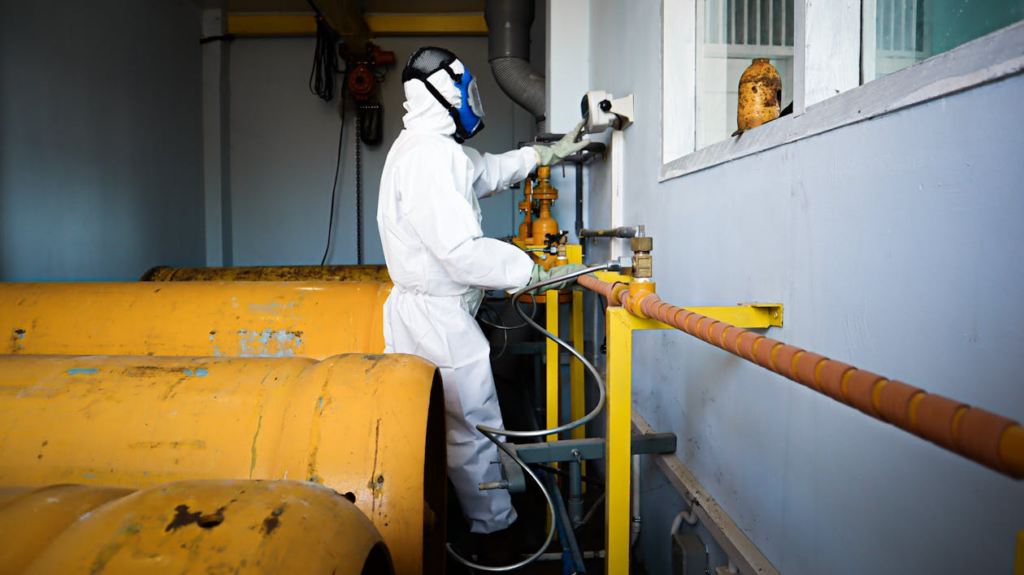
Personal protective equipment requirements go well beyond the basic respirators many workers expect. Class I and Class II asbestos work — the categories covering most renovation and maintenance activities — requires full-body disposable suits, specialized respirators with HEPA filters, and specific decontamination procedures before leaving the work area. Workers often underestimate the time and cost involved in proper protective protocols, which can add substantial duration to seemingly simple projects.
What Are the Legal Requirements for Asbestos Abatement and Disclosure?
Mandatory Asbestos Disclosure and Contractor Licensing
New Mexico’s Property Disclosure Act creates legal obligations that extend far beyond federal requirements, particularly for residential property transactions. Sellers must disclose any known presence of asbestos-containing materials, but the law’s complexity lies in defining what constitutes “known presence.” Properties built before 1980 are presumed to contain asbestos unless testing proves otherwise, shifting the burden of proof onto sellers who want to avoid disclosure requirements.
The contractor licensing framework operates through a tiered system that many construction professionals find surprisingly restrictive. Basic asbestos awareness training allows workers to handle small-scale projects involving less than three square feet of material, but anything larger requires specialized licensing through the New Mexico Environment Department. Supervisors must hold Class I licenses that require 32 hours of initial training plus annual recertification, while larger abatement projects demand Class II licenses with even more extensive qualifications.
Notification requirements create another compliance hurdle that frequently trips up contractors. Projects must be reported to the Environment Department at least ten working days before asbestos work begins, with specific forms documenting the scope of work, waste disposal plans, and worker certification levels. Emergency projects receive expedited review, but “emergency” has a narrow legal definition that excludes most situations contractors might consider urgent.
Legal Responsibilities in Safe Asbestos Removal
Safe removal procedures carry legal weight that goes beyond industry best practices — they’re enforceable requirements with significant penalties for violations. The state requires complete containment of work areas using plastic sheeting and negative air pressure systems, with specific protocols for waste bagging and disposal that must be documented throughout the project. These aren’t suggestions; they’re legal mandates that can result in stop-work orders and substantial fines if not followed precisely.
Waste disposal presents particular challenges in New Mexico due to limited approved facilities and long transport distances. All asbestos waste must be disposed of at EPA-approved landfills, but the nearest facility might be hundreds of miles away, creating logistical and cost challenges that many contractors don’t anticipate. The legal responsibility for proper disposal follows the waste from generation to final disposal, meaning contractors remain liable even after the material leaves their job site.
Documentation requirements create a paper trail that regulators use to verify compliance long after projects conclude. Every aspect of asbestos work must be recorded, from initial testing results through final clearance air sampling, with specific forms required at each stage. Many contractors discover too late that incomplete documentation can result in project rejection and legal liability, even when the actual removal work was performed correctly. The records must be maintained for thirty years — longer than many small contractors remain in business — creating ongoing compliance obligations that outlast the original project.
What Health Risks and Legal Rights Are Linked to Asbestos Exposure?
Asbestos exposure creates health risks that unfold over decades, with the most serious conditions — mesothelioma, lung cancer, and asbestosis — typically developing 20 to 50 years after initial exposure. This extended latency period creates unique legal challenges because victims often can’t identify when or where their exposure occurred, particularly if they worked in multiple industries or lived in various locations throughout their careers. The medical evidence shows that even brief exposure to high concentrations of asbestos fibers can trigger disease decades later, making any level of unprotected exposure legally significant.
The connection between exposure and illness isn’t always straightforward from a legal perspective. While medical research clearly establishes that asbestos causes mesothelioma, proving specific exposure sources in individual cases requires detailed occupational and residential histories that many people struggle to reconstruct accurately. New Mexico’s industrial history — including mining operations, military installations, and older commercial buildings — creates multiple potential exposure sources that can complicate the process of establishing liability in legal proceedings.
Legal rights for asbestos exposure victims in New Mexico encompass several different avenues for seeking compensation. Personal injury claims against employers or product manufacturers require proving that exposure occurred due to negligence or defective products, while workers’ compensation claims provide benefits regardless of fault but often with lower compensation limits. For individuals facing serious diagnoses like mesothelioma, consulting with a mesothelioma compensation lawyer becomes critical early in the process, as New Mexico’s statute of limitations typically allows only three years from the date of diagnosis to file legal claims.
The state’s legal framework also recognizes unique exposure scenarios that federal law doesn’t specifically address. Family members who developed illness from secondhand exposure — such as spouses who regularly washed work clothes contaminated with asbestos fibers — have successfully pursued compensation through New Mexico courts. These cases require different legal strategies than traditional occupational exposure claims and often involve multiple defendants across various industries.
Compensation calculations in successful asbestos cases typically include medical expenses, lost wages, pain and suffering, and in cases of wrongful death, loss of support for surviving family members. New Mexico courts have recognized that mesothelioma’s devastating prognosis justifies substantial compensation awards, but the actual amounts vary widely based on factors like age at diagnosis, work history, and the strength of evidence linking exposure to specific defendants. The availability of asbestos bankruptcy trust funds can also influence compensation strategies, as many former asbestos manufacturers have established funds to pay claims even after declaring bankruptcy.
How Does the Asbestos Litigation Process Work in New Mexico?
Roles of Plaintiffs and Defendants in Asbestos Cases
Asbestos litigation in New Mexico typically involves multiple defendants due to the widespread industrial use of asbestos-containing products throughout much of the 20th century. Plaintiffs must identify not only their direct employers but also manufacturers of specific products they encountered, contractors who installed asbestos materials, and property owners who failed to warn of exposure risks. This multi-defendant structure means that each party’s role in causing harm must be established separately, often requiring extensive discovery to uncover decades-old employment records and product usage information.
Defendants in asbestos cases employ various legal strategies that plaintiffs must be prepared to counter. Product manufacturers often argue that their specific products didn’t contribute to the plaintiff’s illness, while employers typically claim that safety standards in effect during the exposure period met legal requirements. Property owners frequently contend that they had no knowledge of asbestos presence or that any exposure was minimal and legally insignificant.
The burden of proof requires plaintiffs to establish both medical causation — that asbestos exposure caused their illness — and legal causation — that specific defendants contributed to that exposure through negligent conduct. This dual requirement often involves testimony from medical experts, industrial hygienists, and former coworkers who can verify exposure circumstances. The quality and availability of this evidence frequently determines case outcomes more than the severity of the plaintiff’s illness.
Typical Timeline and Key Court Decisions
New Mexico asbestos cases generally follow a compressed timeline compared to other personal injury claims due to the urgent nature of mesothelioma diagnoses. Initial case filing typically occurs within months of diagnosis, followed by expedited discovery that prioritizes the most critical evidence. Courts often allow depositions to proceed on an accelerated schedule when plaintiffs face terminal diagnoses, recognizing that testimony preservation may be necessary if the plaintiff’s condition deteriorates.
The discovery phase focuses heavily on reconstructing exposure history through employment records, product identification evidence, and witness testimony. This process can take six to twelve months, during which both sides gather evidence about specific products, workplace conditions, and safety practices in effect during relevant time periods. The complexity of this evidence-gathering often surprises families who assumed that obvious exposure would lead to straightforward legal proceedings.
New Mexico courts have established important precedents that shape current litigation strategies. The state supreme court’s ruling in Silva v. Town of Questa established that municipalities can be held liable for exposing residents to asbestos contamination, while decisions in various product liability cases have clarified standards for proving that specific manufacturers’ products contributed to individual illnesses. These precedents provide guidance for both plaintiffs and defendants but also highlight the fact-intensive nature of asbestos litigation that makes each case’s outcome difficult to predict.
Settlement negotiations often occur throughout the litigation process, with most cases resolving before trial. The timing and amount of settlements depend heavily on the strength of exposure evidence, the plaintiff’s prognosis, and the financial resources of available defendants. New Mexico’s legal environment generally supports fair compensation for verified asbestos exposure victims, but successful outcomes require thorough preparation and strategic case development that accounts for the state’s specific legal standards and procedural requirements.
Understanding these legal frameworks matters most when decisions need to be made quickly. For anyone facing an asbestos-related diagnosis, the intersection of medical urgency and legal deadlines means that early consultation with qualified legal counsel can preserve options that might otherwise disappear as time passes and evidence becomes harder to reconstruct.