South Carolina Motorcycle Crash Investigations and Legal Updates
Fatal motorcycle crashes are climbing in South Carolina, and the pattern isn’t random. Here’s what you should know about how the Highway Patrol investigates these collisions, how fault gets assessed in left-turn accidents, and what the law actually says about wrongful death claims.
The Open Road Meets a Deadly Reality
For a lot of riders, motorcycles represent something close to pure freedom; an unfiltered connection between you, the machine, and whatever stretch of highway you’re chasing. It’s a deeply American feeling, and anyone who’s ridden through the Lowcountry on a warm evening gets it instantly.
But in 2026, that freedom is colliding with a brutal and increasingly common reality on South Carolina roads. A surge in fatal motorcycle collisions, particularly at intersections in counties like Richland, Spartanburg, and York, has turned busy crossroads into scenes of tragedy. Reports from WIS TV, Yahoo News, and WBTV have all documented the trend in recent months.
What’s troubling is the consistency. National data published by PubMed shows that about 26% of fatal two-vehicle motorcycle crashes happen when another vehicle is turning left. Sound familiar? It should, because that exact scenario keeps repeating across the state. This piece breaks down the legal machinery behind those headlines, from how the South Carolina Highway Patrol reconstructs the crash to what legal options families may have afterward.
What’s Behind the Surge in SC Motorcycle Intersection Crashes?
The “Looked But Failed to See” Phenomenon
Crash investigators have a term for something that sounds almost paradoxical: “inattentional blindness.” It’s when a driver looks directly at an oncoming motorcycle and genuinely doesn’t register it’s there. If you’ve ever been so focused on finding a gap in traffic that you missed something right in front of you, you’ve experienced a mild version of the same cognitive lapse.
The motorcycle’s smaller profile makes the problem worse. Drivers routinely misjudge how fast a bike is approaching and how little time they have to complete a left turn. Think of it like the difference between spotting a delivery truck and spotting a bicycle at 200 yards; your brain processes those two objects very differently, even if they’re traveling at the same speed.
The Legal Duty to Yield in South Carolina
The legal principle here is straightforward: drivers intending to make a left turn have a duty to yield the right-of-way to oncoming traffic. That’s not a suggestion or a courtesy; it’s a requirement under state law.
When a driver fails to yield, that violation frequently forms the core basis of legal fault. Reports examining motorcycle crash trends across South Carolina have flagged this single violation as a leading cause of serious and fatal collisions at intersections.
A Statewide Problem by the Numbers
The scale of this issue shows up clearly in both national and local data. Here are the numbers worth paying attention to:
- Soaring fatality rate: Federal data underscores a stark reality for riders. According to the NHTSA, when accounting for actual miles driven on the road, the likelihood of a fatal accident is dramatically higher for motorcyclists compared to people in passenger vehicles.
- A disturbing trend: South Carolina reported a 33% increase in motorcycle crashes from 2020 to 2021, based on publicly available summaries of state crash data. That kind of jump doesn’t happen without systemic contributing factors.
- Intersections as hotspots: Research and crash reporting consistently identify intersections as among the most dangerous locations for motorcyclists, with left-turning vehicles presenting the primary hazard time and again.
The Anatomy of a Crash Investigation
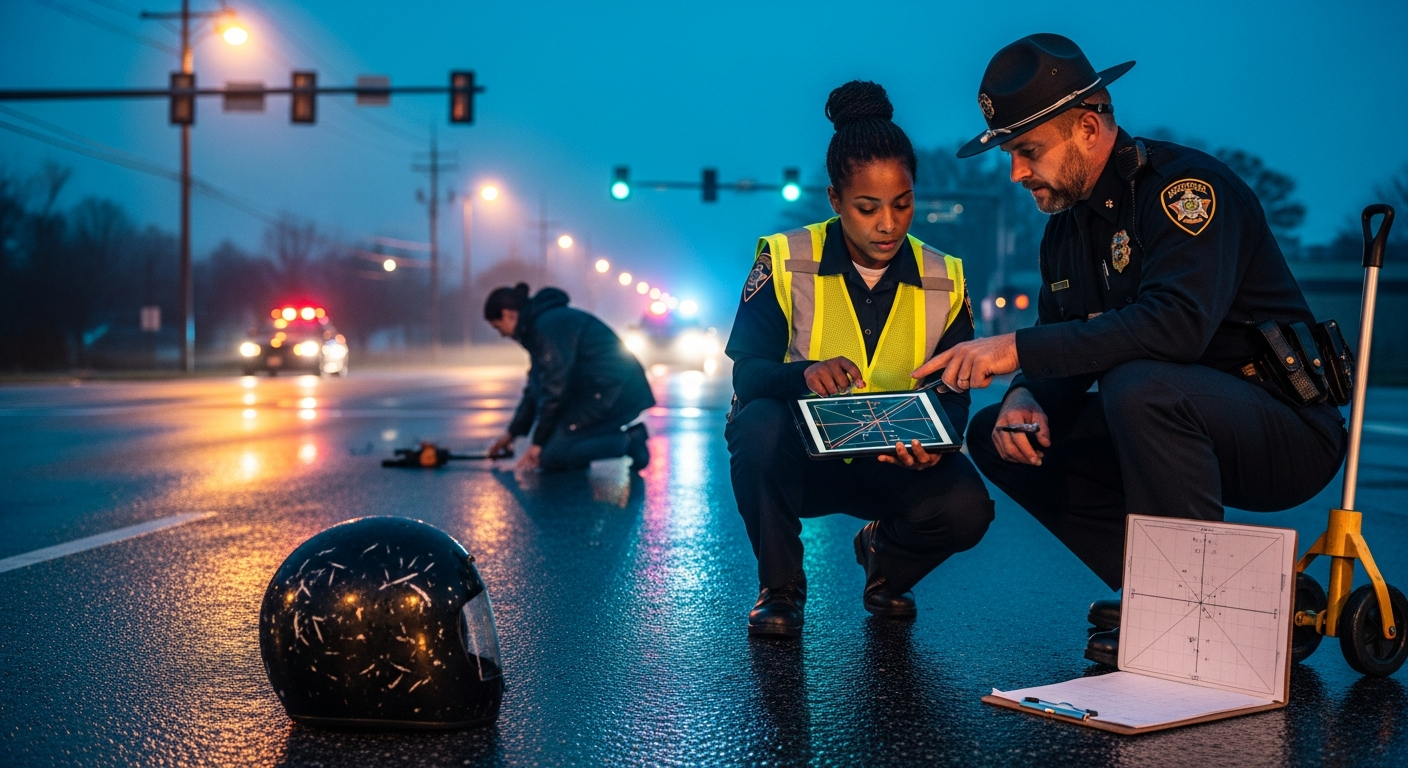
Right after a serious collision, the South Carolina Highway Patrol (SCHP) launches an investigation to determine the probable cause. This goes well beyond filling out a standard accident report, and whatever the investigators find can shape every insurance claim or lawsuit that follows.
At the scene, investigators collect a wide range of evidence to reconstruct what happened. That typically includes physical evidence such as skid marks and vehicle debris, statements from witnesses, electronic data from a vehicle’s event data recorder (the car’s “black box,” essentially), and any available traffic camera or dashcam footage. Each piece of that puzzle matters when the question of legal responsibility comes up later.
Establishing fault means applying South Carolina law to that collected evidence, not just reading the police report and calling it a day. For anyone trying to understand what happens if a left-turning driver hits a motorcyclist in this state, the answer depends heavily on how those facts line up under the state’s negligence rules.
The Legal Stakes: Right-of-Way, Negligence, and Wrongful Death
How South Carolina’s Negligence Laws Compare
Injured motorcyclists in South Carolina are subject to the state’s modified comparative fault system. This rule allows you to pursue compensation from a negligent driver even if your own actions played a role in the crash, as long as you bear no more than 50% of the total responsibility.
However, your final payout is directly docked by your degree of responsibility. For instance, being found 20% at fault means you will receive only 80% of the total settlement. This framework is significantly more lenient than what you’ll find in some nearby states. Here is a look at how regional guidelines compare:
| State | Rule Type | Practical Impact for Riders |
| South Carolina | Modified comparative negligence (51% bar) | Rider can recover if 50% or less at fault; a 50/50 split means you still collect half your damages. |
| North Carolina | Pure contributory negligence | Rider is barred from any financial recovery if found even 1% at fault. |
| Georgia | Modified comparative negligence (50% bar) | Rider must be 49% or less at fault; a 50/50 split completely bars you from recovery. |
The Path to Accountability
Violating a road rule, such as failing to yield, provides the necessary groundwork for a personal injury or wrongful death claim if that action results in a fatal crash. In civil litigation, this type of statutory violation is known as ‘negligence per se’ and serves as powerful evidence of fault.
For families dealing with the aftermath of a fatal collision, filing a wrongful death lawsuit may be the only path forward. This civil action is initiated by the deceased person’s personal representative to secure financial recovery for the surviving beneficiaries.
A wrongful death action allows surviving family members to pursue damages for final medical bills, burial expenses, anticipated lifetime earnings, and the emotional loss of care and guidance. Ultimately, these lawsuits provide a critical legal and financial safety net for families facing sudden, devastating losses.
Beyond the Headlines: Seeking Accountability on South Carolina’s Roads
Something as routine as a left turn has become one of the most lethal threats to motorcyclists. The recent fatalities reported across Richland, Spartanburg, and York counties make that painfully clear.
News reports capture the immediate tragedy, but the legal system provides a structured, fact-based process for sorting out who’s responsible. Highway Patrol investigations and South Carolina’s negligence statutes are the primary tools that victims and their families can use to pursue accountability after a crash.
Understanding the legal framework behind these events won’t bring anyone back. But it’s an important step toward greater public awareness and, eventually, safer roads for everyone who shares them.