
California’s Workplace Safety Reckoning: How First Aid Certification Is Becoming Los Angeles Employers’ Strongest Defense Against Negligence Claims in 2026
California has long been recognized as a battleground for some of the most stringent, aggressively enforced employer liability and labor protection laws in the United States. From rigorous wage-and-hour audits to comprehensive ergonomic mandates, operating a business in Los Angeles requires navigating a massive web of compliance. As we move into June 2026, a new legal reckoning is sweeping through the city’s corporate boardrooms, manufacturing floors, and tech incubators. The conversation around workplace safety is shifting away from theoretical risk assessments and focusing heavily on immediate biological response. Protecting your workforce from physical trauma and sudden medical crises is no longer viewed simply as a moral imperative; it is a strict, undeniable legal obligation. Today, comprehensive, fully documented first aid certification is rapidly becoming a Los Angeles employer’s most reliable shield against catastrophic negligence claims.
The Legal Landscape of Liability
To understand the magnitude of this shift, one must view the modern workplace through the lens of liability. In an era marked by heightened legal awareness and aggressive plaintiff litigation, the standard of care expected from an employer has risen dramatically. When a severe medical emergency occurs on company property—whether it is an industrial accident in a San Fernando Valley warehouse, a sudden cardiac arrest in a Century City law firm, or a severe allergic reaction in an arts-district studio—the immediate aftermath is invariably scrutinized by compliance officers and legal counsel.
If an employee collapses and the surrounding staff is completely untrained, the resulting chaos is not just a human tragedy; it is a profound legal vulnerability. Waiting helplessly for paramedics to arrive while a coworker bleeds heavily or suffers brain hypoxia due to a stopped heart opens the door to devastating claims of “Failure to Train,” “Breach of Duty of Care,” and “Gross Negligence.” In the eyes of the law, ignoring the biological reality of workplace emergencies is tantamount to ignoring a severed power line on the office floor.
By proactively mandating first aid training Los Angeles for management, supervisors, and a high percentage of the general staff, employers establish a vital, documented baseline of care. It provides incontrovertible proof that the company took measurable, industry-standard steps to mitigate biological risks, drastically reducing exposure to negligence lawsuits while genuinely protecting human life.
The Ambiguity of “Near Proximity” and Cal/OSHA Section 3400
The driving force behind this legal reckoning is the strict enforcement of California occupational health and safety regulations. Under Cal/OSHA Title 8, Section 3400 (Medical Services and First Aid), the law explicitly states that employers must ensure the ready availability of medical personnel for advice and consultation on matters of industrial health or injury.
Crucially, the regulation dictates that if an infirmary, clinic, or hospital is not in “near proximity” to the workplace for the treatment of all injured employees, the employer must have one or more persons adequately trained to render first aid on-site.
read more : https://lawsuitzone.com/
The legal trap for many Los Angeles employers lies in the interpretation of the phrase “near proximity.” This is not defined by a simple mileage radius. Historically, courts and Cal/OSHA compliance officers have interpreted “near proximity” based on the timeframe of biological survival—specifically, a 3-to-4 minute emergency response time.
In emergency medicine, the first four minutes following a cardiovascular collapse or a severed artery are critical. If the brain is deprived of oxygen for longer than four to six minutes, irreversible cellular death begins. Therefore, if a hospital cannot be reached, or an ambulance cannot arrive at the patient’s side within that 3-to-4 minute window, the workplace is not considered to be in “near proximity.”
The Los Angeles Infrastructure Problem
When you apply the 3-to-4 minute “near proximity” standard to the geographical reality of Los Angeles, the legal exposure for employers becomes terrifyingly clear.
Los Angeles is defined by its massive urban sprawl and legendary traffic gridlock. Even if your office is physically located just two miles from Cedars-Sinai Medical Center, the functional reality of reaching that hospital during the afternoon rush hour entirely negates the proximity. Furthermore, navigating a heavy ambulance through congested surface streets, clearing commercial security gates, waiting for freight elevators in a high-rise, and locating the specific suite where the emergency occurred adds critical minutes to the response time.
For an LA employer to rely solely on the 911 dispatch system as their primary workplace safety protocol is a massive failure of risk management. It is a mathematical impossibility for paramedics to reliably breach the four-minute window in this city. Consequently, the legal burden of the initial medical response falls squarely on the employer. You must have trained personnel already inside the building, ready to act as the manual, biological bridge until the professionals arrive.
The Good Samaritan Act: Protecting the Employee and the Employer
One of the most persistent barriers to implementing widespread CPR and first aid training in the corporate sector is the fear of vicarious liability. HR directors frequently express concern: If we train our employees to perform CPR, and they make a mistake that injures the patient, will the company be sued?
This fear, while understandable, is mitigated by strong statutory protections in California. The state’s Good Samaritan Law (Health and Safety Code Section 1799.102) is explicitly designed to encourage bystanders to intervene in emergencies without the paralyzing fear of litigation. The law states that no person who in good faith, and not for compensation, renders emergency medical or nonmedical care at the scene of an emergency shall be liable for any civil damages resulting from any act or omission.
When an employer provides standardized, federally recognized training (such as programs aligned with the American Red Cross or American Heart Association guidelines), they empower their employees to act within a protected legal framework. As long as the employee acts voluntarily, within the general scope of the physical skills they were taught, and does not exhibit willful, gross negligence, they are shielded from civil liability for accidental injuries—such as breaking a rib during chest compressions. By extension, this heavily insulates the employer from claims that their designated first aiders caused undue harm.
Integrating AEDs: The Legal Standard of Care
As technology evolves, so does the legal definition of a “Standard of Care.” Decades ago, a standard first aid kit was considered sufficient. Today, the Automated External Defibrillator (AED) is rapidly transitioning from a recommended workplace accessory to an expected legal necessity.
Sudden cardiac arrest is a leading cause of death in the American workplace. Early defibrillation is the only proven method to restore a normal heart rhythm. Modern AEDs are highly sophisticated, algorithm-driven smart devices that use AI to analyze the heart and verbally instruct the user on how to proceed. They are designed to be foolproof for laypeople.
In 2026, if an employee suffers a cardiac arrest in a major corporate office and there is no AED available, or the staff is entirely untrained on how to pull it off the wall and use it, plaintiff attorneys will aggressively argue that the employer failed to meet the modern standard of care. Investing in AED hardware and the first aid certification required to use it is one of the most cost-effective liability mitigations a company can make.
Maintaining Operational Uptime: The Blended Learning Solution
Historically, the operational cost of pulling a large segment of the workforce off the floor for two days of classroom training was a major deterrent for employers. It meant lost productivity and disrupted project timelines.
The safety training industry has solved this friction through the “Blended Learning” model, which perfectly balances legal compliance with operational efficiency. Employees complete the cognitive and theoretical requirements of the certification—learning the physiology of the heart, the legalities of care, and the mechanics of wound packing—online via an interactive Learning Management System.
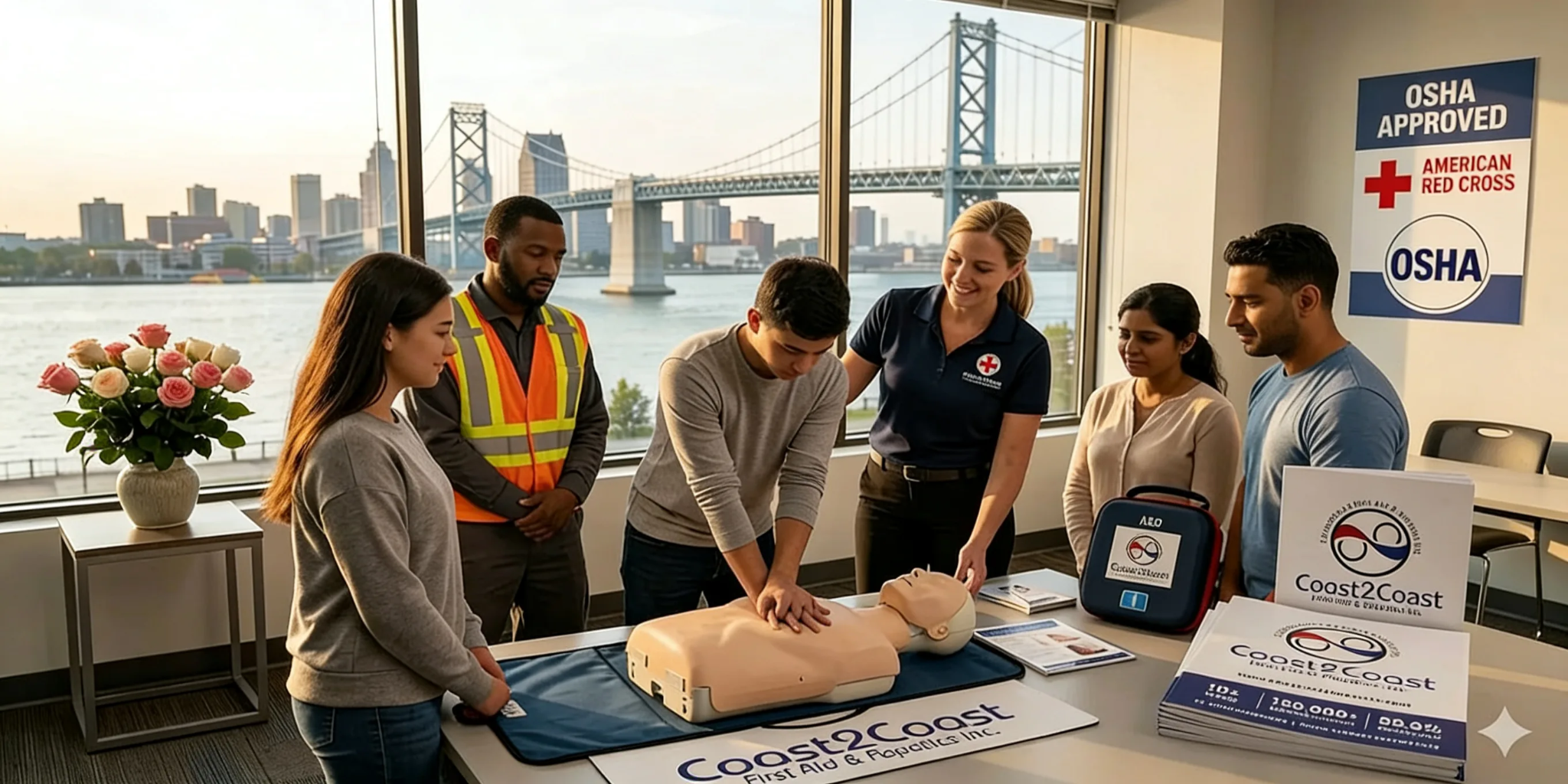
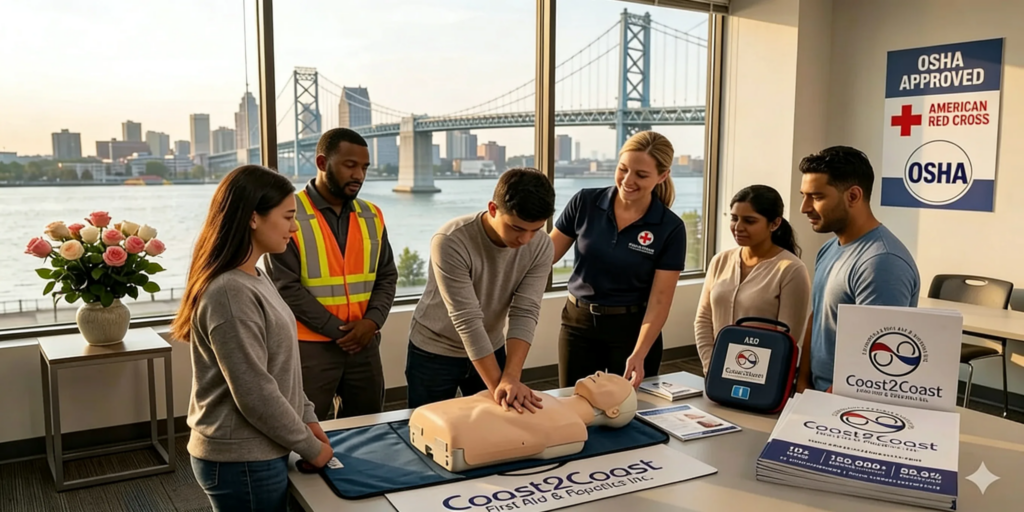
Once the digital modules are completed asynchronously on their own schedule, the employees attend a highly condensed, single in-person session in Los Angeles. During this physical session, they demonstrate their skills on Bluetooth-enabled smart manikins that provide objective, digital data on compression depth and rate. This hybrid model allows LA employers to mass-certify their workforce, secure their legal liability shield, and maintain their operational uptime.
Conclusion: The Ultimate Defensive Strategy
In the highly litigious environment of California, hope is not a viable risk management strategy. You cannot hope that a medical emergency never occurs on your property, and you cannot hope that traffic will magically part for an ambulance.
The strongest defense an employer can build is a documented, proactive offense. By investing in comprehensive first aid and CPR certification for your team, you are not just ticking a compliance box. You are building an impenetrable wall against negligence claims, fostering a deeply appreciated culture of safety among your staff, and ensuring that if the worst happens, your company is prepared to save a life.
Frequently Asked Questions
1. How often does an employer need to renew employee first aid certifications in California? To maintain strict compliance with Cal/OSHA regulations and to ensure that the employer’s liability shield remains intact, certifications must be kept current. Certifications issued by major recognized bodies (such as the American Red Cross) are valid for two years. Employees must successfully complete a recertification course prior to the expiration date on their card. Lapsed certifications offer zero legal or compliance protection.
2. Are we legally required to purchase an AED for our specific office suite? While Cal/OSHA does not explicitly mandate an AED for every single private office suite in California, the broader legal “Standard of Care” is shifting rapidly. Many commercial insurance providers now heavily incentivize or require the installation of public-access AEDs to mitigate catastrophic civil liability claims. If your building does not have one easily accessible within a 90-second round trip, purchasing one is highly advised by legal and safety experts.
3. Does the first aid training cover how to document an incident for HR and legal purposes? Yes. A comprehensive workplace safety training course does not just teach physical mechanics; it teaches scene management and legal reporting. Employees are trained on the importance of the “Chain of Survival,” which includes how to properly interact with 911 dispatchers, how to verbally secure consent before touching a patient, and the basic principles of handing the scene over to arriving paramedics—all of which are critical for post-incident reporting and liability protection.
4. Can an employee refuse to provide CPR if they are certified? Yes. Unless the employee’s specific job description explicitly outlines emergency medical response as a mandatory duty (such as a designated corporate safety officer or an on-duty lifeguard), general employees who hold a certification are not legally compelled to intervene under California law. The Good Samaritan Act protects those who volunteer to help, but it does not mandate action from private citizens.
5. Are fully online first aid certificates legally recognized by Cal/OSHA? No. This is a common and dangerous compliance trap for employers. While fully online courses are excellent for cognitive learning, Cal/OSHA regulations legally require a practical, hands-on physical assessment to issue a valid workplace certificate. The “Blended Learning” model is fully compliant and legally defensible because it pairs the online cognitive theory with a mandatory, in-person physical skills test evaluated by a certified instructor.