Conservator vs Power of Attorney: Your Complete Legal Blueprint
Introduction
Things don’t always work out the way they should. A sudden illness, a terminal disease like dementia, or an accident can render an individual incapable of making significant financial or medical decisions. That’s when families typically turn to each other and wonder: Who makes the decisions now?
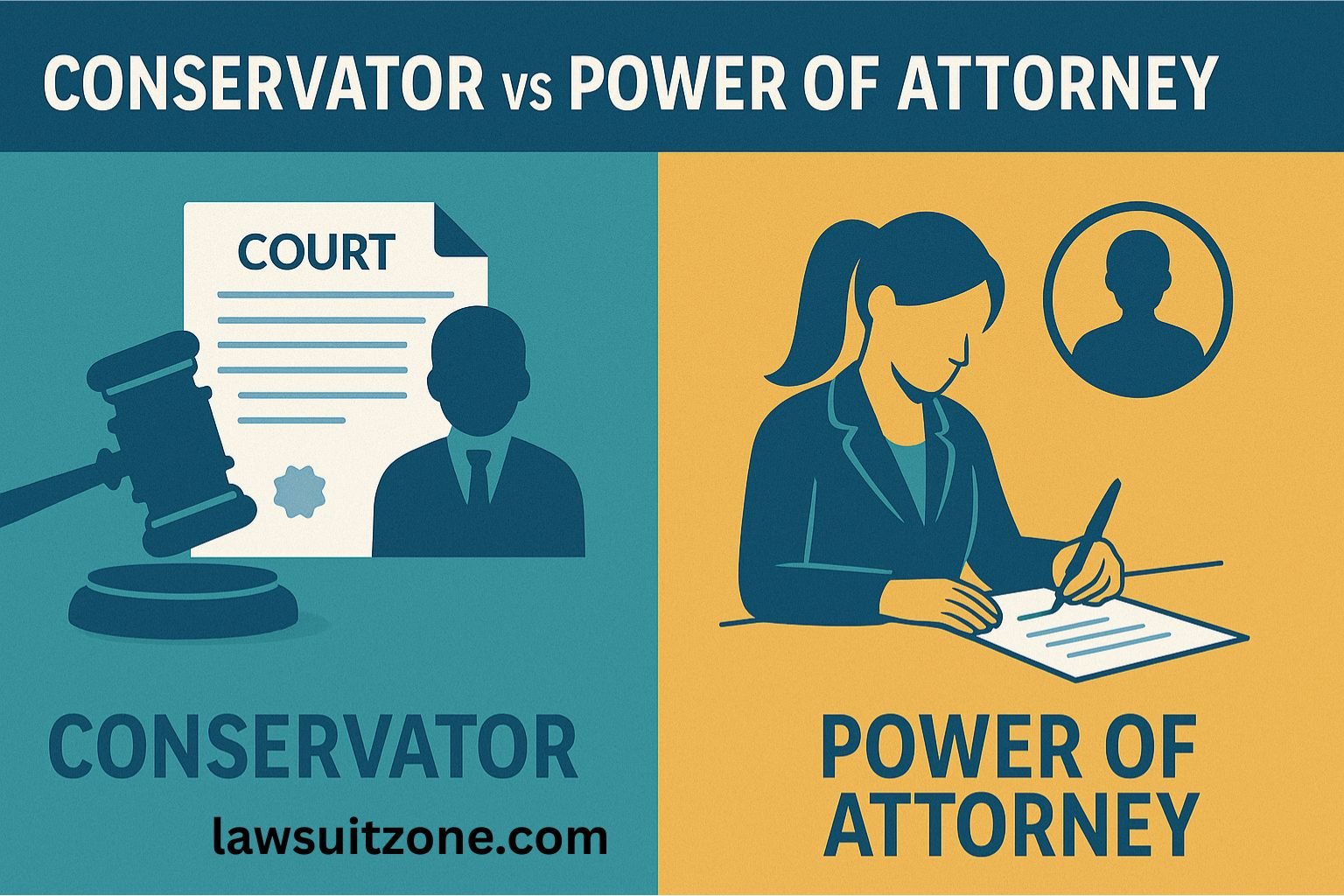
That’s where the legal concepts of conservator vs power of attorney come in. Both exist to protect individuals who need help but they work in very different ways.
If you’ve ever wondered which option fits your family’s situation, this guide is for you. We’ll break down what each means, how they’re created, the pros and cons, and real-world examples that make the differences crystal clear. Have you checked our detailed guide on attorney vs lawyer.
What is a Conservator?
A conservator is a court-appointed guardian who takes over someone else’s affairs. This occurs when the court determines that a person (referred to as the “conservatee”) is unable to manage their own financial, healthcare, or personal affairs.
Two Principal Types of Conservators
- Conservator of the Person: Manages healthcare, living situation, and general well-being.
- Conservator of the Estate: Manages money, property, and business affairs.
Why Courts Intervene
- To avoid financial abuse of vulnerable adults.
- To offer guidance when family members do not agree.
- To hold people accountable with mandated court reports.
Simply put, conservatorship is a safeguard of last resort.
What is a Power of Attorney (POA)?
A power of attorney is a legal form you draft to grant another person you trust the power to make decisions on your behalf. In contrast to conservatorship, this is your choice — not the court’s.
Common Types of POA
- General POA: Gives wide-ranging powers, like control over bank accounts or property.
- Durable POA: Remains valid even if you’re incapacitated.
- Limited or Special POA: Gives authority for a specific task (e.g., selling your home while you’re abroad).
- Medical POA (Healthcare Proxy): Names an individual to make medical decisions when you’re unable.
POA is just about planning ahead and maintaining control by deciding whom you’d want to act for you.
Conservator vs Power of Attorney: Key Differences
Let’s lay out the most important contrasts in plain English:
| Factor | Conservator | Power of Attorney |
|---|---|---|
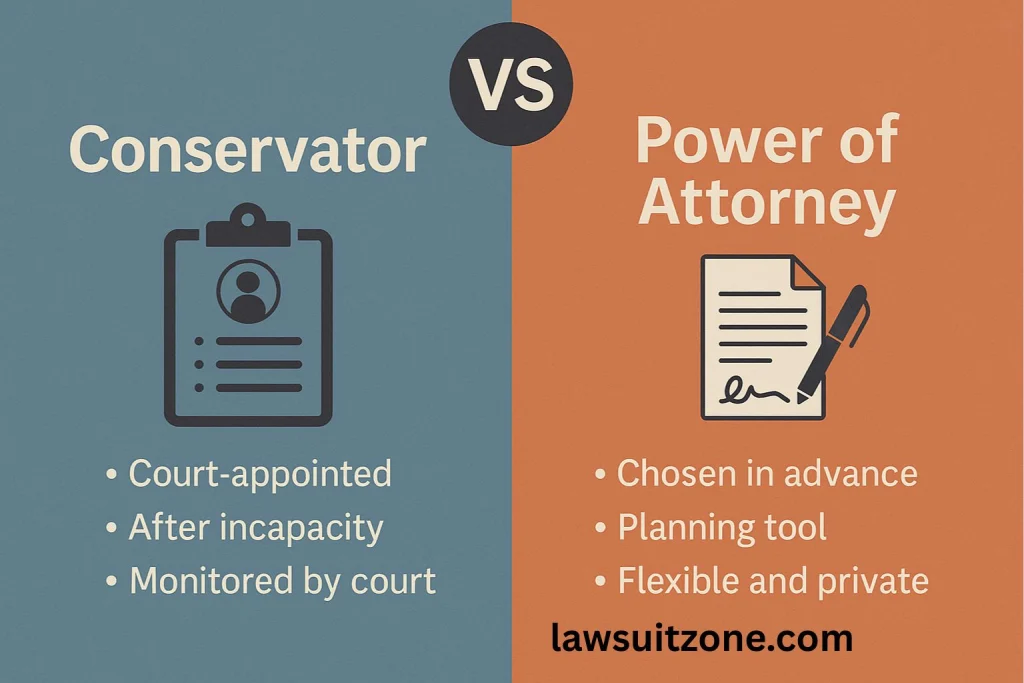
| Who Decides? | Court appoints | You choose the agent |
| Oversight | Court reviews and monitors | No court involvement unless challenged |
| Cost | Court fees, attorney fees, ongoing reporting | Usually just drafting and notarization costs |
| Flexibility | Restricted by court order | Highly customizable |
| When Used | After incapacity, when no POA exists | While you’re capable, to prepare for the future |
Consider this: a conservator is appointed when it’s too late to plan, whereas a power of attorney is selected when you can still plan ahead.
When a Conservator is Necessary
Conservatorship is usually needed when:
- An elderly parent gets Alzheimer’s without designating a POA.
- A disabled adult needs to have finances managed in a structured manner.
- A family conflict makes it impossible to reach an agreement on care.
- There’s proof of neglect, exploitation, or unsafe living.
Although it provides strong protection, conservatorship can feel heavy-handed because it takes personal choice away.
When Power of Attorney Works Best
A POA is the smarter option if:
- You want control over who manages your affairs.
- You’re planning ahead for aging, travel, or health risks.
- You prefer a private arrangement without court oversight.
- You need flexibility, such as appointing different people for finances and healthcare.
It’s empowering and proactive — but it needs trust. Choosing the wrong person could result in abuse or mismanagement.
Pros and Cons of Each
Conservatorship Pros
- Robust legal protections.
- Court supervision discourages abuse.
- Solves family disputes with legal authority.
Conservatorship Cons
- Expensive and time-consuming.
- Strips personal independence.
- Feels intrusive.
Power of Attorney Pros
- Inexpensive and easy to establish.
- Tailorable to you.
- Keeps things confidential.
- Fosters planning and independence.
Power of Attorney Cons
- Needs capacity to establish.
- Dangerous if you name the wrong one.
- May not apply to every circumstance when poorly written.
A Tale of Two Families
- Family One: John never executed a POA. When he had a stroke, his kids quarreled over who would control his finances. The court intervened, had a conservator appointed, and now they need court approval for all big decisions. It’s secure but expensive and stressful.
- Family Two: Maria had an enduring POA years before. When she was diagnosed with dementia, her daughter was able to handle her bills and medical treatment instantly without any delays through the courts. Life stayed stable and confidential.
This side-by-side illustrates how important advance planning is.
Conservator vs Power of Attorney Worldwide
- United States: Separation between conservatorship and POA is recognized everywhere.
- United Kingdom: Same idea, but they use words like guardian or lasting power of attorney (LPA).
- Canada & Australia: Guardianship (court appointed) vs enduring power of attorney (selected).
- Civil Law Countries (France, Spain, Germany): Better understanding of “mandates” and “guardians,” but same essential notion — voluntary decision vs court action.
Such a universal look demonstrates the difficulty is the same worldwide: autonomy vs protection.
Human Side of the Debate
It’s simple to get lost in legalese, but these judgments impact actual lives. For countless seniors, relinquishing control resembles losing identity. For families, intervention can engender guilt, conflict, or relief.
For this reason, the discussion of conservator vs power of attorney should include empathy, honesty, and family conversation — not merely legal documents.
Best Practices for Families
- Don’t Wait: Create a durable POA prior to health deterioration.
- Select Reliable Agents: Abilities are less important than character.
- Maintain Open Communication: Communicate your desires to loved ones to prevent conflict.
- Review Periodically: Revise papers after milestones in your life.
- Secure Legal Assistance: An estate planning lawyer can make papers enforceable under state law.
Why This Distinction Matters
Understanding conservator vs power of attorney can be the difference between easy decision-making and a lengthy court fight. With advance planning, families save resources and maintain dignity. Without it, the courts might intervene — sometimes in ways that aren’t what the person wants.
For additional information on legal planning and guardianship, the U.S. Courts website is a trusted source of information and guidance.
Frequently Asked Questions (FAQs)
Conclusion
The decision between power of attorney vs conservator is not only legal — it’s personal.
- A conservator has been appointed by the court when a person can’t take care of their life and never established a plan.
- A power of attorney is designed by the person, providing flexibility, trust, and privacy.
If you place importance on independence, get a POA in place. If your loved one is already incapacitated, conservatorship might be all that’s left.
In short: a power of attorney symbolizes empowerment, while a conservatorship symbolizes protection when all else fails.