How Language Barriers Impact Civil Rights in California Traffic Reports
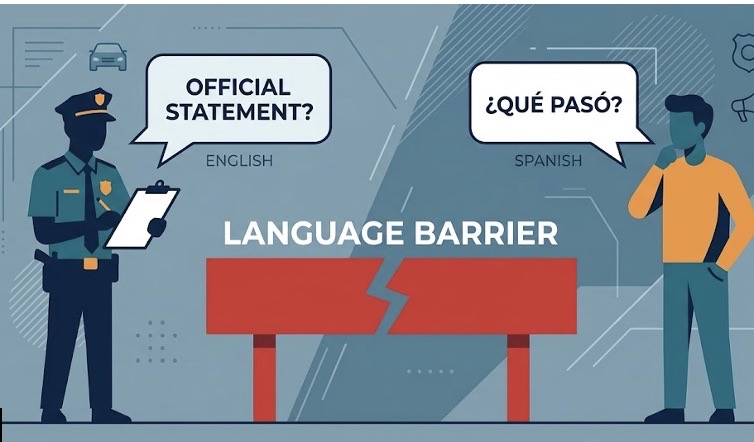
The immediate aftermath of a serious traffic collision is often a chaotic scene of emergency lights, debris, and high adrenaline. For those involved in an accident with a commercial vehicle, the stakes are exceptionally high due to the potential for severe injury and significant property damage. In these moments, the responding police officer acts as the primary gatekeeper of information. The officer’s report becomes the foundation for insurance claims and civil litigation. However, a significant problem arises when there is a language gap between the officer and the victim. When a person with limited English proficiency cannot communicate their side of the story, their civil rights and their path to justice are placed at risk.
The Legal Framework: The Dymally-Alatorre Bilingual Services Act
In California, the right to receive services in one’s native language is not merely a matter of convenience; it is a statutory requirement for many state and local agencies. The Dymally-Alatorre Bilingual Services Act, found in California Government Code Section 7290, was established to ensure that individuals who do not speak or write English are not shut out from government services. This law mandates that state and local agencies serving a substantial number of non-English-speaking people must employ a sufficient number of bilingual staff or provide qualified interpreters.
This state law mirrors federal protections found in Title VI of the Civil Rights Act of 1964. Title VI prohibits discrimination based on national origin, which the courts have often interpreted to include language access, by any entity that receives federal financial assistance. When a police department fails to provide adequate translation services during a major investigation, it creates a systemic barrier that can lead to inaccurate legal outcomes.
Why Language Access Matters in the Central Valley
The geographical and demographic realities of California make this a pressing issue for the legal community. For example, the Central Valley serves as a massive logistics hub where heavy freight traffic on Highway 99 and Interstate 5 is constant. This area also has a very high percentage of Spanish-speaking residents. In regions with high Hispanic populations, the demand for bilingual legal representation is high. Victims often rely on abogados de accidentes de camión en Bakersfield to challenge police reports that were incorrectly translated or biased due to a lack of communication.
When an officer relies on a bystander or an untrained person to translate at the scene of a truck accident, the risk of error is immense. Technical terms regarding vehicle mechanics, speed, or the sequence of events can be easily misinterpreted. These errors are then transcribed into an official police report, which carries significant weight in the eyes of insurance adjusters and jurors.
The Evidentiary Weight of Ad Hoc Translations
From a legal perspective, an “ad hoc” translation—one performed by an unqualified person at the scene—is highly problematic. Under the California Evidence Code, statements made through an interpreter can sometimes be treated as hearsay or challenged for their lack of reliability. If an officer testifies that a victim admitted to a certain action, but that admission was filtered through a child, a neighbor, or the other driver, the integrity of that evidence is compromised.
Law students and future practitioners should understand that a police report is not an infallible document. If the report was generated without the use of a qualified interpreter as required by state policy, it may be possible to impeach the officer’s testimony or the report’s findings. This is a critical point in civil rights litigation because it highlights how a lack of resources can lead to the “official” narrative being dominated by the English-speaking party, regardless of who was actually at fault.
For those entering the legal profession, advocating for clients with limited English proficiency requires a proactive approach. It is not enough to simply translate documents. Attorneys must investigate the circumstances under which statements were taken at the accident scene. Was a qualified interpreter present? Did the officer follow the department’s language access plan? If not, there may be grounds to argue that the client’s due process rights were hindered.
Future lawyers can also advocate for policy changes within law enforcement agencies. Ensuring that every patrol car has access to a telephonic interpretation service is a relatively low-cost solution that can prevent massive injustices. When the facts of an accident are recorded accurately from the start, the legal system functions more fairly for everyone involved.
Conclusion: Ensuring Equal Justice for All
True access to justice should not depend on the language a person speaks. When a language barrier prevents a victim from explaining how an accident occurred, the legal system fails in its primary mission to find the truth. By holding state agencies accountable to laws like the Dymally-Alatorre Act and emphasizing the need for professional translation, the legal community can help protect the civil rights of all Californians. Whether in a courtroom or at the side of a highway, every person deserves the right to be understood.